
Advocates make the case for Alzheimer's screening on Capitol Hill
More than 1,000 Alzheimer's Association advocates converged on Capitol Hill on June 2 to share their stories and advance policy priorities critical to the Alzheimer's and dementia community. During the 2026 Alzheimer's Impact Movement (AIM) Advocacy Forum in Washington, D.C., advocates from all 50 states met with their members of Congress to share why legislation like the Alzheimer's Screening and Prevention (ASAP) Act is so personal — and so urgent.
Blood tests that can detect Alzheimer's biomarkers already exist — and they work. But under current law, Medicare cannot cover any screening test for diseases that cause dementia, leaving a legal barrier between patients and the early detection they need. Congress can remove that barrier by passing the ASAP Act. The bipartisan bill gives Medicare the authority to cover Food and Drug Administration (FDA)-approved blood biomarker screening tests, using the same proven approach Congress recently applied for cancer through the MCED Act.
During their meetings, advocates drew a clear parallel to a landmark moment in cancer care: When Congress enabled Medicare coverage for routine mammograms, screening rates soared and deaths dropped significantly. Congress can deliver that same "mammogram moment" for Alzheimer's.
A young advocate with history
Catherine Dooley of Oklahoma is only 23, but she is no stranger to the Alzheimer's Association — or to the toll the disease can take on a family. When she was 12, she watched her mother and grandmother care for her grandfather and helped out however she could. Her grandfather was one of eight siblings, six of whom died with Alzheimer's disease. He also once stood where Dooley stood Tuesday, advocating in our nation's capitol nearly 30 years ago for his own father.
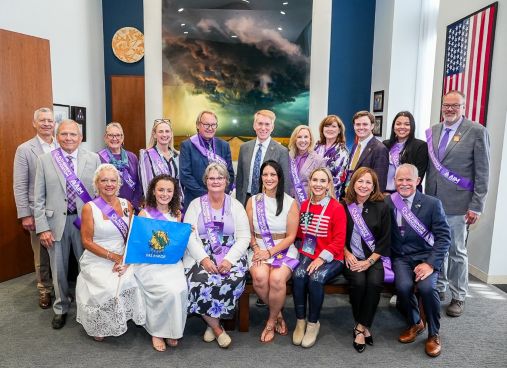
The Oklahoma delegation with Sen. Lankford
Dooley joined fellow Oklahoma advocates in a meeting with Sen. James Lankford (R-Okla.) to urge his support for the ASAP Act. "I had always dreamed of some sort of test that was quicker and less extensive than what my grandfather had to go through," she said. "The ASAP Act does that. It's something families across America have imagined. We're finally on the edge of that being a reality."
Personal and professional commitment
Danielle "Dani" Micale of New Jersey is attending her 16th Advocacy Forum — and her commitment to the cause is both personal and professional. A health care professional with a 30-year career focused on aging and neurocognitive disorders, Micale was first drawn to the Alzheimer's Association when her grandmother was diagnosed.
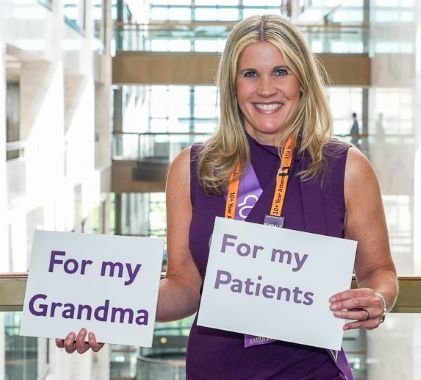
Dani Micale
"I advocate because I was a primary caregiver to my own grandma, Milly, who lost a 14-year battle with Alzheimer's disease," Micale said. "But I'm also here for the people I am blessed to work with every day."
Micale and fellow New Jersey advocates met with Sen. Andy Kim (D-N.J.) — who recently publicly shared his personal connection to Alzheimer's — to urge him to cosponsor the ASAP Act. During the meeting, Sen. Kim and the advocates connected over a shared understanding of sandwich generation caregiving.
Make it simple
Advocates from across Wyoming met with Sen. John Barrasso (R-Wyo.), sharing personal stories to highlight the urgency of the ASAP Act. As Senate majority whip, Barrasso has significant influence over the legislative agenda.
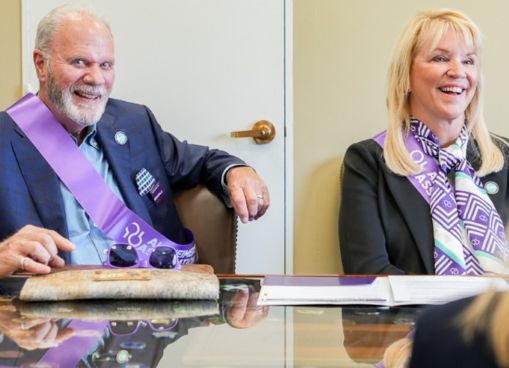
Tom and Tracy Hayes
Among them was Tracy Hayes, whose mother and sisters all lived with Alzheimer's disease. Her mother's diagnosis came only a couple of years before she died — an experience that drove Hayes to get involved with the Association.
"Because I was involved with the Association and knew how to find resources, getting my husband, Tom, his diagnosis was fairly straightforward," Hayes said. "The ASAP Act would make it simple for others."
Learn more about the ASAP Act and how you can grow support for this critical bipartisan legislation.

Contact Us
General information
Email: advocacy@alz.org
Phone: 312.335.5833
Program
Annetha Hall
Email: ahall@alz.org
Phone: 202.638.8665
AIM information
Email: support@alzimpact.org
Phone: 202.638.8671
News media
Email: media@alz.org
Phone: 312.335.4078