
Science, stories and a call to action at 2026 AIM Advocacy Forum
The final morning of the 2026 AIM Advocacy Forum brought together researchers, policymakers, caregivers and advocates for a powerful close to three days of purpose and progress in Washington, D.C.
Alzheimer's Association President and CEO and AIM CEO Joanne Pike, DrPH, welcomed advocates back to the main stage and set the tone for what was ahead. "This is a pivotal moment for Alzheimer's research and policy," Pike said. "The science is delivering — real treatments, real diagnostics, real hope. This is the moment we've been working toward, and your advocacy is what's making it possible."
Pike then opened the program with a fireside chat alongside Dr. Jay Bhattacharya, director of the National Institutes of Health (NIH), and Sen. Jerry Moran (R-Kan.). Bhattacharya oversees the world's largest funder of biomedical research, and in his first professional judgment budget called on Congress to invest an additional $187.210 million in Alzheimer's research for fiscal year 2027. Moran has been a longtime champion for Alzheimer's research and care on Capitol Hill, bringing a legislative perspective to the conversation on where federal policy goes next.
"It's a very exciting time for Alzheimer's research," said Bhattacharya. "Investments in Alzheimer's research over decades are finally paying off."
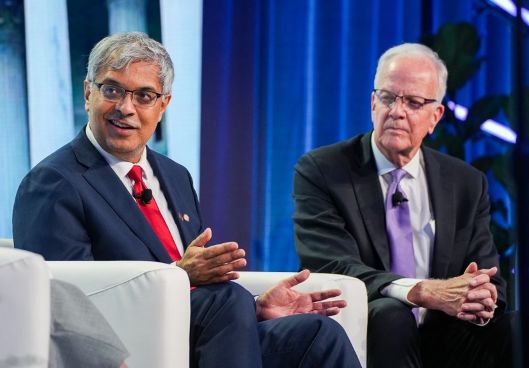
Dr. Jay Bhattacharya and Sen. Jerry Moran (R-Kan.)
"We're always looking for things that resonate across party lines," said Moran. "I've seen Republican and Democratic senators come together on NIH research generally and Alzheimer's specifically."
He went on to recognize the role of the Alzheimer’s Association and AIM advocates in developing the broad bipartisan coalition of support in Congress. “You do it so well. It’s some of the best I’ve seen in my time in Washington, D.C.,” said Moran.
A personal connection
Sen. Andy Kim (D-N.J.) then offered a perspective that is both legislative and deeply personal. His father — a geneticist who spent his career studying Alzheimer's disease — has himself been diagnosed with it. "Alzheimer's has erased my father's memory of his life's work of trying to cure Alzheimer's," Kim said.
When he learned of his father's diagnosis, he chose to speak openly and to channel that experience into action — and he told the advocates in the room that their courage made his possible.
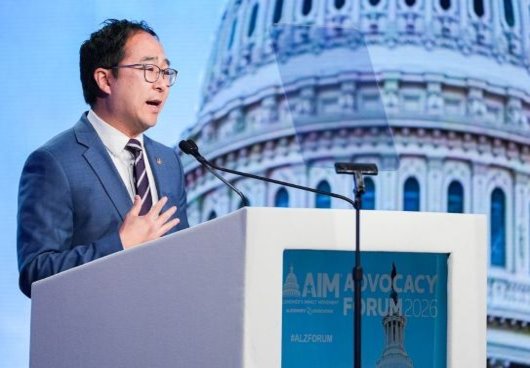
Sen. Andy Kim (R-N.J.)
"I would not have shared my story if it wasn't for you sharing your stories," he said. "I'm proud to say, because of what I learned from you, I have decided to sign onto the ASAP Act." Kim pledged to support the bipartisan Alzheimer's Screening and Prevention (ASAP) Act, which would remove the Medicare barrier to coverage of blood tests that can detect Alzheimer's before symptoms appear.
His remarks led directly into the morning's caregiver panel, moderated by Alzheimer's Association and AIM Vice President of Advocacy Beth McMullen, which featured three advocates whose own experiences with the disease brought them to Washington. All three panelists drew a direct line between their experiences and the urgent need to pass the ASAP Act.
Liana Redshaw of Illinois is a caregiver for her husband, Ryan, an Army veteran living with younger-onset Alzheimer's and traumatic brain injury. Liana was five months pregnant when she left her career as a social worker to become Ryan's full-time caregiver. A 2025 Elizabeth Dole Foundation Fellow, she has been a tireless voice for military families — advocating for blood test access legislation, dementia training for providers, and the elimination of the 24-month Medicare waiting period for people with younger-onset Alzheimer's.
"It's a very lonely journey if I'm not coming out here and using my voice," Redshaw said. "Your story is powerful and it's worth sharing. Collectively, we can make a change."
A game changer
Sally Oelschlager Vulich of Arizona was caring for her husband living with younger-onset Alzheimer's when her mother started showing symptoms. She found her way to advocacy — testifying before the Nevada legislature and speaking publicly to push for better systems for families facing dementia.
"Early detection would have been a game changer," Vulich said. "It is about moving forward. For my daughter and future generations, it is a game changer."
Calvin Hara of Hawaii brought more than 30 years of professional experience in senior care to the stage — and something no training could provide: the experience of caring for his mother and uncle as they lived with dementia. Now a community educator for the Alzheimer's Association Hawaii Chapter, Calvin regularly speaks on brain health and early detection and has attended the Forum eight of the last 10 years.
"When we hear about screening, a blood test for Alzheimer's, that means hope," Hara said. "Our children and grandchildren hopefully will not need to have a discussion about how to care for someone with Alzheimer's."
Saving the next generation
The morning closed with two award presentations. John Chandler of New York received the 2026 Emerging Advocate of the Year Award after collecting 312 petition signatures, meeting with members of Congress and advocating publicly following his own Alzheimer's diagnosis.
"This is not an 'old' person's disease, it can impact anyone," Chandler said. "It may be too late for me — I hope not — but it's not too late to save the next generation."
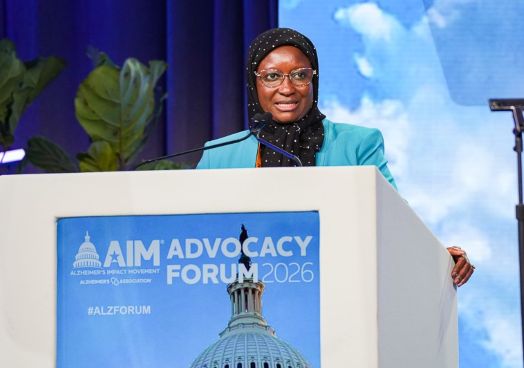
Fatou Ceesay of Wisconsin
The Alzheimer's Congressional Team of the Year Award went to the team from Wisconsin's Second Congressional District, led by Ambassador Fatou Ceesay, for building a sustained relationship with Rep. Mark Pocan (D-Wis.) that secured his cosponsorship of the ASAP Act and the AADAPT Act.
"Every story matters. Every meeting matters. Every act of advocacy matters," Ceesay said in accepting the team's award.
Pike closed the Forum by reminding advocates of how far the movement has come — and how much further it has to go.
"Treatments exist today because of what advocates in this room fought for," she said. "Coverage exists because of what advocates in this room fought for. We are not done."

Contact Us
General information
Email: advocacy@alz.org
Phone: 312.335.5833
Program
Annetha Hall
Email: ahall@alz.org
Phone: 202.638.8665
AIM information
Email: support@alzimpact.org
Phone: 202.638.8671
News media
Email: media@alz.org
Phone: 312.335.4078