

Make Twice the Impact This World Alzheimer’s Day
Make Twice the Impact This World Alzheimer’s Day
Double your impact during our World Alzheimer’s Day 2x Match Challenge. Your gift can go twice as far to accelerate research and help provide care and support for millions affected by Alzheimer’s.
Donate NowAs a caregiver for a loved one with Alzheimer's or other dementia, what are the questions or advice you dread the most? “Does he know you?...He seems just fine to me…” The misinformation about the disease, and how it is experienced by the individual as well as family members, can be frustrating. Even medical professionals are not immune from the faux pas. A group of family caregivers share their experiences and recommendations.
“He seems just fine”…comforting words you SHOULDN’T say to an Alzheimer’s caregiver
There are nearly 12 million Americans providing unpaid care for 7.4 million loved ones living with Alzheimer’s disease. If you haven’t run into one of them yet, it’s likely that you will soon. And when you do, you might find yourself at a loss for something to say.
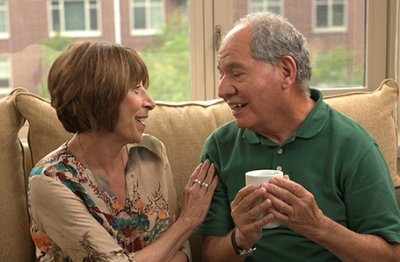 If you were to ask participants in a caregiver support group, organized by the Alzheimer's Association, you might be surprised to learn that the well-intentioned platitudes we’re inclined to offer may have the exact opposite effect.
Friends can say the darndest things
- “He seems just fine to me.” For Becky Orr of Denver, this one hits home. “People want to reassure us,” she said, not realizing that the caregiver who is ‘on duty’ 24 hours a day, gets to see many other sides of their loved one. “At first, I didn’t know what to say, I was so upset. Now, I can say ‘I know. I'm glad you got to see him in such a good place, but people with Alzheimer's usually lose memory and judgment before communication skills. So, although you see his easy communication today, there are still many things he needs support with at home and throughout the day. Alzheimer's symptoms are much more ‘invisible’ than other health issues, particularly in the beginning and middle stages.’
- Mattye Pollard-Cole of Centennial reinforced that message. At her husband’s 60th birthday party, more than four years after he was diagnosed with Alzheimer’s and only two years before his death, one friend asked: “Are you sure Cliff has Alzheimer’s? He seems find to me.” Pollard-Cole noted: “I don’t think people realize that a person with Alzheimer’s can have good days and bad days and, in Cliff’s case, do a good job of covering up his illness.”
- “Does he know you?” This is among the most gut-wrenching questions any dementia caregiver faces, and to be quizzed by an acquaintance can be an emotional experience. Better to focus on the caregiver and allow them to raise a topic like this.
- It’s important to understand that as many as 80% of people living with dementia suffer from the inability to identify familiar faces – typically in moderate to severe stages – although some never lose the ability to recognize loved ones.
- “Does he wander?” Many people don’t understand the changing phases of dementia, and that the initial diagnosis does not mean that the person automatically has progressed to the end phase, which in some cases can take well over a decade.
- Once again, wandering is a common symptom. An estimated 60% of Alzheimer’s patients wander – often in the mid to late stages.
“There are moments when you’re at your wits end and say: “are you open to learning a little more about Alzheimer's?” said Ellen Datino of Centennial. “I have certain friends I can do that with, but not others.”
Unsolicited advice
The key message here is “don’t give it. Ever.” Retired hospice nurse Ruth Fletcher of Denver notes that she has dealt with a number of people who are “unable to let that go.
“This has been a pet peeve of mine and I’ve had to set a boundary with some folks,” she said. “I’ve had to go as far as to say: ‘Don’t tell me how to take care of my husband.’”
Misconceptions & fears
While there are more than 7.4 million Americans living with Alzheimer’s and it is the sixth-leading cause of death, many people whose lives have not been touched by dementia have misconceptions about it that can lead to isolation for the family living with the disease and, sometimes, hurtful situations.
“A lot of people think dementia is contagious,” said one support group member.
“There are myths,” said Orr. “I don’t know why people are so intimidated. I think it’s fear, especially since the (aging) demographic is growing.”
And for the families that are coping with their own fears and grief, being confronted with uninformed reactions from those around them just encourages them to isolate.
For another caregiver, who lives with her husband in an active 55+ community, her husband’s diagnosis has caused many friends and acquaintances to shun them.
“It’s an isolating disease,” she said. “I noticed that as people learned of our diagnosis, I could see them praying: ‘don’t come to our table and sit down.’”
Coping with the medical community
Surprisingly, some of the most challenging situations occur in dealing with doctors and their staff members – those who we might expect to be most familiar with and educated about working with people living with dementia.
“Doctors often don’t include essential next steps for families when discussing the diagnosis,” said Debra Wells of Centennial. “They give us a diagnosis and tell us to come back in six months.”
One caregiver noted that after her husband had a stroke, she brought him to the doctor’s office for x-rays, and the staff quickly separated her from her husband for his examination.
“He was frightened, and didn’t know what to do with the x-ray smock,” she said. “You’d think that medical staff would know how to deal with dementia patients, but they don’t. You don’t walk into a dementia patient’s room at 2 a.m. and grab his arm to check his vitals. He has no idea what’s going on.”
What caregivers want from their doctors
Beyond more specific training for medical staff so they can better deal with patients who are living with Alzheimer's or other forms of dementia, the caregivers were united in their plea for doctors to help families better understand the diagnosis that they provide, and offer concrete guidance.
“Docs need a 101 course in diagnosis, not only to help the family cope with the impending loss and fear of going on this path for a long time, but also the concrete things to do now while our loved one is as lucid as he will be,” said a group participant. “Seeing an attorney and seeing a financial advisor…getting that taken care of is comforting and having your spouse sign forms while he’s lucid and knows what he’s doing.”
For other family caregivers, just getting the dementia diagnosis isn’t particularly useful.
“What if it’s Lewy Body disease versus Alzheimer's versus frontotemporal dementia,” said one caregiver. “Each comes with a decision tree and very different outcomes, and it’s helpful to know what to expect.”
A referral to subject matter experts is Pollard-Cole’s recommendation. “The best advice I received from our wonderful doctor was ‘Call the Alzheimer’s Association!’ I was immediately connected to resources and a community of caregivers and staff.”
Tips for coping
The methods that the family caregivers use to navigate their daily lives are as diverse as the problems they face, but several are used by multiple caregivers:
- Informative cards – One participant noted that she carries cards that she offers to many of the people who interact with her and her husband. The 3” x 5” cards contain information that people may need to understand the situation, such as her husband’s name, his medical condition, the stage of the disease and how it may affect his behavior. “I give them to waiters and bring them to medical appointments where I give them to everyone from the receptionist to the nurse and the doctor,” she said. “It cuts through the clutter.”
- The “on call” friend – For Datino, the confusion and isolation caused by the disease have helped her realize that she needs to have a “go to” friend to call when the need arises. “It’s good advice to know who the person is you can talk with at any time, no matter what,” she said. “Find your friend. Trying to figure out ‘how we’re going to do life’ when we’re 59 years old and find ourselves facing Alzheimer’s disease is tough on your own.”
- Set boundaries – As the second wife to husband, Pat, Ruth Fletcher has had to deal with some second-guessing from his family members. In anticipation of that, before the holidays a few years ago, she sent a message to family that said, in part: “The best thing you can do for Pat/us is to show up… Long periods of silence are hurtful to him. Please keep in touch. And don’t worry about having the right things to say - because there are none…it is not helpful to suggest things we ‘should be doing’ or ‘should be trying.’ He puts all his energy in trying to maintain the things he can do. And even those are declining. Do not tell anyone how to feel. No one is in our shoes or has been. Do not give advice unless we ask for it…We have this. I have this. The best thing that helps is to just show up. We will let you know when we NEED something. And those times will come.”
- Listen to concerned parties – Sometimes insights can come from unexpected sources. Judy Lyons of Denver notes that when her husband, Frank, was experiencing symptoms at a younger age, the tip to seek a medical assessment came from his supervisor at work who was seeing different behavioral changes than she was at home. While the diagnosis process took about 18 months because of Frank’s younger age, it helped the family to finally move forward.
- The support group – Lastly, the group of family caregivers who shared their experiences is the best lifeline. Originally established by the Alzheimer's Association to run for 12 weeks, this support group, like many others, has remained together for years. “This support group is special,” Datino noted. “We have all reached out. Half of us have lost our person, but we’re still here. This journey is lifelong.”
To learn more about Alzheimer's support groups, or the programs and services provided at no charge by the Alzheimer's Association, go to alz.org, or call the Association’s free Helpline, staffed 24/7 by trained professionals, at 800-272-3900.