

Make Twice the Impact Right Now
Make Twice the Impact Right Now
Our Autumn 2x Match Challenge is happening right now. Until midnight on Oct. 12, your gift can go twice as far to advance research, promote brain health and help provide care and support for those impacted by Alzheimer’s.
Donate Now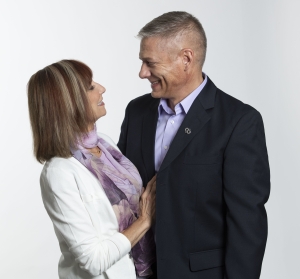 November is National Family Caregivers Month and National Alzheimer's Disease Awareness Month — a time to honor the millions of families facing this disease together. For Kerry Dennis, 59, who is living with early-stage Alzheimer's, and her husband and care partner, Rob, this journey is one of patience and purpose. Together, they're redefining what it means to live fully — and to love through change.
Kerry, what does Rob as a care partner mean to you?
My husband, Rob, means the world to me. He's my steady hand, my sounding board, and the one who helps me stay grounded when things feel uncertain. Living with early-stage Alzheimer's isn't easy, but he shows up every day with patience, kindness and love.
I've always been independent; it's who I am, and he gets that. He's learned how to let me take the lead when I can and to gently step in when I need help, even if I don't want to admit it. That balance isn't easy, and I know this journey asks a lot of him. I'm so grateful for the way he sees me, not just the diagnosis but the whole me.
How has Rob's support made a difference in your life?
His support has turned something that could feel really isolating into something we face together. He helps me stay on track with appointments, changes, emotions — all of it. And he does it with so much patience and care. Because of him, I can keep showing up, keep advocating and reminding people that early-stage Alzheimer's doesn't mean invisible.
But maybe the biggest difference Rob's support has made is this: He's helped me let him in. Letting go of control hasn't come easy. I'm learning to release some of the things my former self would've clung to, and that's not weakness, it's growth. His support makes that possible. He gives me space to be who I am, while gently holding the parts I can't carry alone.
What would you say to other families just beginning this journey?
This is a journey, and it's OK if you don't have it all figured out. There will be hard days, but there will also be beautiful ones. Try not to get so caught up in what's coming that you miss the good stuff happening right now. Enjoy the quiet moments doing the things you love together, don't forget to laugh, and make time for the things that matter. Lean on each other. Be honest. Give grace. You don't have to do it perfectly; you just have to keep showing up.
Rob, what have you learned being a care partner for Kerry?
Being a care partner for Kerry means walking hand in hand with her through a journey neither of us expected — but one we're facing together. It's about noticing the quiet shifts: when she hesitates over a familiar task or searches for a word that used to come easily. Instead of stepping in to fix it, I step beside her — to support, to encourage, to adapt. We've had to find new rhythms, new ways to do things that used to be second nature. I've learned that my role isn't to take over. It's to help her hold on to her independence, her dignity and her joy. And every day, I'm reminded that love isn't just about being there when things are easy — it's about showing up, fully, when things get hard.
What's something you wish you'd known earlier about being a care partner?
That being a care partner doesn't mean carrying the weight alone. There's a powerful support system available — especially through the Alzheimer's Association — that offers guidance, resources and community. I also have learned to recognize the value of self-care. When I take time to recharge, I can show up for Kerry with the love, patience and resilience she deserves.
What's been the most meaningful part of supporting Kerry during this journey?
Watching Kerry bring hope to others facing Alzheimer's. Her joy in that purpose has reignited something in both of us. We've learned to live more intentionally, creating memories now while we still can and embracing each day with love, laughter and gratitude.
About Kerry and Rob: For 35 years, Kerry built a successful career in finance at Fidelity. But about two years ago, simple tasks at work became increasingly difficult. At age 59, Kerry was diagnosed with mild cognitive impairment (MCI). As a member of the 2025-2026 National Early-Stage Advisory Group, Kerry is committed to helping others live well with the disease and to changing the narrative around Alzheimer's. Kerry and Rob live in Auburn, New Hampshire. They have four children.