

Make Twice the Impact This World Alzheimer’s Day
Make Twice the Impact This World Alzheimer’s Day
Double your impact during our World Alzheimer’s Day 2x Match Challenge. Your gift before midnight on Sept. 21 can go twice as far to accelerate research and help provide care and support for millions affected by Alzheimer’s.
Donate NowThe Memory Keeper: One Woman’s Story of Love, Loss, and Alzheimer’s
Love, Memory, and the Written Word
"What's a Toaster?" Such a few innocuous words, but they stopped me dead in my meal preparation. The questioner was not a non-English speaker, nor a toddler, but my 82 year old husband. His guileless expression was not forced or joking. The old man sitting a few feet away from me in his navy fleece robe, his once abundant sandy hair now sparse and silvery grey, awaited the answer to his question with the trusting honesty of a child.
Busy with meal prep when he said he wanted a snack, I had impatiently snapped,
"Have a piece of toast; you know where the toaster is!"
Bob had Alzheimer's disease. We were several years along in our personal journey with this illness. How many years would be hard to determine. Scientists believe that the amyloid plaques and tau tangles that affect the mind may start twenty to thirty years before the first symptoms of Alzheimer's appear.
When did it start with Bob? Hard to say. There were odd little things in the early 2000's. Sometimes he stared off into space and seemed to be in another world. Occasionally he'd say something surprisingly inappropriate. Were these behavioral quirks, "guy" things, or early signs of Alzheimer's?
Bob's mother had had dementia of some kind. By 2010, Bob's younger brother had been diagnosed with Alzheimer's, but he was still able to continue living at home and handle day-to-day activities.
Around 2011 our son, also named Bob, began to notice that his father's behavior in the
office was "goofy" at times. Father and son worked together in the insurance business my
husband had started in 1974. With a string of professional designations behind his name, Bob Sr. was not one to tolerate less than professional behavior at work, yet ... he would answer the phone inappropriately, seem confused with basic insurance questions at times, and use reams of paper making endless and unnecessary copies. In fall of 2011, with a disruptive and heartbreaking family conference, our son, daughter, and I told Bob that maybe it was time to retire and leave all the office business to his son. He was understandably angry. Still, we were confused as to what was really occurring in his life, in our lives.
Other signs appeared. Bob and I played American Mah jongg and pinochle regularly. Bob started to consistently overbid in pinochle. Once at mahjongg, he threw up his hands and said, "I don't know what I've got!"
It was in January of 2012 when he'd once again overbid in a pinochle game at our senior center, angering his partner, that I drove to Bob's doctor's office in tears and poured my heart out to the doctor who'd been my husband's primary for almost thirty years. What was going on with Bob?
The steps to getting a diagnosis were not easy and straightforward. His physician died unexpectedly. Our search for another in our medical plan was made more difficult because we left our home in Tucson for three months for our summer place over 200 miles away in Show Low. We found one doctor who then unexpectedly moved to Phoenix.
There are many forms of dementia besides Alzheimer's and many physical problems can contribute to confuse the diagnosis. It was months before Bob began taking drugs that would hopefully slow the progress of the disease. He could still discuss insurance problems with an amazingly clear mind. We could often play games and go about daily activities quite normally, at least for the first few years. At times though, there was confusion and frustration on both our parts.
One of the most difficult decisions was to have Bob surrender his driver's license because Alzheimer's affects judgment and depth perception. His doctor cooperated by telling Bob that he was an old man, and it was time to sit back and let me chauffeur him around. Bob liked the idea of having a chauffeur!
In 2015, we sold our little place in Show Low because by that time Bob just wanted to be home in Tucson. He needed familiar people and places.
As Bob could do less and less for himself, I took on more and more. Eventually, I was making all the decisions for both of us, while trying to make it appear that the increasingly childlike man to whom I was married had some say in what was occurring. Always an agreeable person, Bob was generally compliant as I introduced caregivers and new routines into our household. The caregivers gave me a much-needed break.
I was tired, frequently frustrated. Angry. Some days I thought I was losing my mind. Confused, unsure of where to turn, I had no choice but to keep going. Is "Lord, what do I do now?" a prayer? Are tears and a broken heart?
I had a support group through the Alzheimer's Association, a group of non-judgmental men and women who were experiencing similar trials with their own loved ones. They listened. They offered suggestions and prayers and hugs. We laughed and cried together.
Ultimately, it was Bob and me. In December of 2016 his health took a turn for the worse and he wound up in the hospital with congestive heart failure. My doctor wanted to put him into assisted living because she was afraid I'd fall and break a hip while trying to help my unsteady husband who still weighed over 200 pounds. I told her that would kill both of us, so we managed to get Bob into in-home hospice. A procession of nurses and aides was soon invading our formerly private, quiet home. Bob slept in a hospital bed across from my bed in our bedroom.
His health deteriorated in March and April because of some kind of flu-like illness. He coughed a lot and had trouble breathing. Early Sunday, April 30, I was awakened by Bob's violent choking cough. He was half out of his bed and couldn't seem to move his legs to get back into bed, and I couldn't lift them either. I called 911, and the fire department soon came. The firemen took vitals and I called hospice for a nurse. After 45 minutes, still no nurse. The fireman told me Bob was not doing very well, and I decided to send him to the hospital. Initially, I thought he had pneumonia and could recover. Our children and other family members came to the hospital, and in late afternoon Bob was sent to a hospice. He died peacefully that night of a brain bleed, with me by his side.
"What's a toaster?" I do not remember the exact day my husband asked that momentous question. I do know that it represented a sea change in his life and mine. His diseased mind had regressed to that of a toddler.
Bob looked expectantly at me. I swallowed, "This," I said, smiling calmly as I dropped a slice of bread into the slot of the small appliance next to me, "is a toaster."
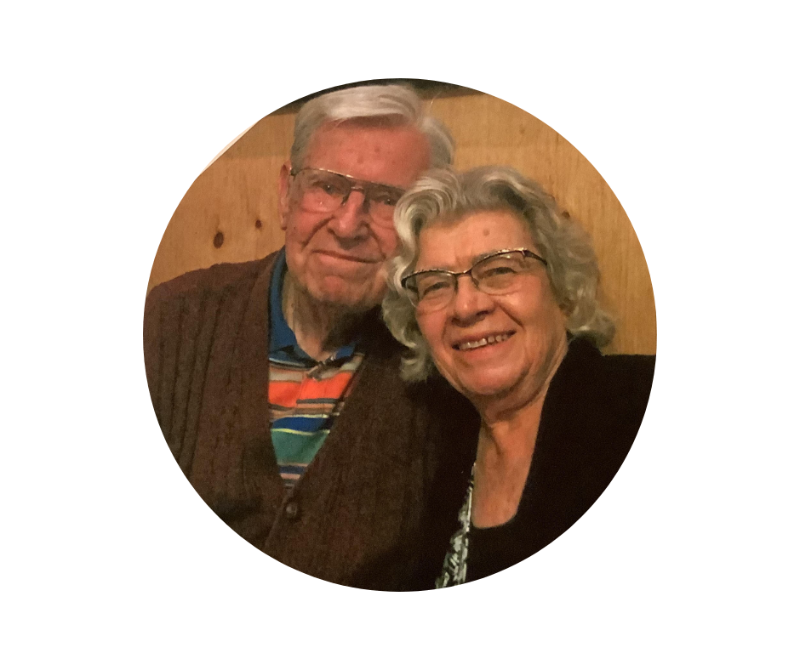
About the Author
Originally from Cleveland, Ohio, Eleanor Arnold moved to Tucson in December 1970 with her husband Bob and their two young children. Although she earned a degree in English, her professional journey led her to teach business classes for 11 years. She also worked alongside her husband in the insurance industry, serving as his secretary and later transitioning into insurance sales. In 1980, they expanded their family by adopting a son.
A woman of many interests, she enjoys oil painting, creative writing, and playing games like mah jongg and pinochle. Her faith plays a central role in her life, and she remains actively involved in her church. Among her many activities, she finds the greatest fulfillment in her work with an Alzheimer’s Association support group, where she offers guidance and compassion to others navigating the challenges of caregiving.
Bob, her husband of 54 years, passed away eight years ago - but his memory continues to inspire her. She often draws on their shared experiences to support others, believing that their journey can help bring comfort and hope to those facing similar paths.