

Twice the Impact During the Dog Days of Summer
Twice the Impact During the Dog Days of Summer
Our End of Summer 2x Match is underway, but not for long. From now until midnight on Aug. 31, your gift can have double the impact on advancing research and helping provide care and support for those impacted by Alzheimer’s.
Donate NowDear New Care Partners:
A friend of mine recently suffered a tragic loss. A man whom she had dated years ago, and with whom she had reconnected just last year, died of a massive heart attack just weeks after they had become engaged to marry. Her loss was instant and overwhelming, but she is already beginning to move past the pain and denial into an acceptance of what life eventually delivers to us all.
Likewise, a diagnosis of Alzheimer’s, or any form of dementia in a partner, also delivers an immediate blow but the process of anger, denial, and acceptance evolves over years as the disease progresses at a snail’s pace in the mind of your loved one.
Caring for a partner with Alzheimer’s is unlike caring for someone with any other condition. Unlike a physical injury, disability or terminal illness, it’s an increasingly lonely occupation because the person you’re caring for is gradually becoming no longer there. Chores that you used to do together, activities that you used to share, are increasingly done in silence with less and less participation by the person you love. You have fewer and fewer meaningful conversations. You sleep farther and farther apart from each other in the bed as your partner’s restlessness interrupts your rare sleep, and even rarer dreams. Romantic intimacy is replaced by cuddles, and cuddles by hugs, as you become increasingly remote from the person you adore. Increasingly, memories recalled are from times before you were together, and shared memories are a thing of the past. Friends disappear, one by one, couple by couple, as the ability to communicate shared experiences moves further and further away.
With Alzheimer’s, becoming a caregiver happens with infinitesimal slowness — it gradually unwinds the bonds of years-long union and reintroduces two distinct individuals to the relationship, except it is no longer a relationship and only one individual is left with the decision how to continue their life forward. For some, there is no question - the promise, “for better or worse, in sickness and in health” is a lifelong commitment; for others, the pain is too great, the demands too onerous. None of us care partners were expecting to have to cope with the life-changing challenges we now face. The answer is to seek out the resources that are offered by the Alzheimer’s Association and others in your community — counselors, home aides, support groups, adult day care, online virtual workshops, hospice volunteers — and employ them to the fullest extent that allows you:
- To spend quality time with your partner in ways that enrich both your lives and reinforce the bonds between you
- To take “me-time” to revive your individuality and refresh your soul
- To learn from the experience of others how to provide the support and comfort your partner needs while preserving the dignity and love that defined your relationship
- To prepare for the future — to lay out a roadmap of the experiences and tasks that lie ahead.
My wife Sara and I are very lucky. Even though she has lost most of her basic cognitive skills — writing, spelling, dressing, bathing, phone, and computer use, driving — we are still able to have occasional conversations and discuss what is the right path ahead – to continue living a “Good Life." These days I prioritize spending quality time together – taking our daily walk, reading books and newspaper articles aloud to her, watching our favorite sports on TV – and leave some of the chores to others. Even though she would prefer not to have caregivers and companions in her house, she recognizes the need for me to have personal time and to have peace of mind that I am not leaving her home alone. We did not come to this place easily; in the first months after her diagnosis, I subjected myself to high levels of stress, trying to become the perfect care partner and making many mistakes along the way. It began to affect my own physical and mental health. It was only by talking to other care partners and other caring souls that I learned to forgive myself for my mistakes and strike a balance between caring and self-preservation.
If you are a new care partner, you too will make mistakes. Learn to forgive yourself and to reach out to the people in your community who can help you strike a life balance that works for you and your partner. You may be scared as you begin to grasp the reality of your situation but understand that your partner is terrified and cannot fully comprehend what the path ahead may bring. With help, you can make that path bearable, and together you too can achieve a good life.
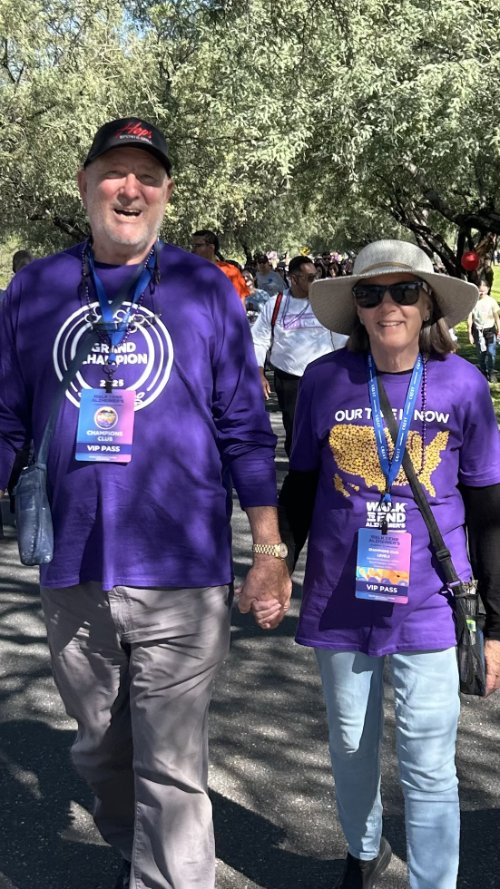
Derek Thomas and his wife, Sara, at the 2025 Tucson Walk to End Alzheimer's.