
Be a Part of the Fight to End Alzheimer's
Be a Part of the Fight to End Alzheimer's
The millions of people impacted by Alzheimer's disease need your help. Your generosity can help us provide care and support to those facing the challenges of Alzheimer's, protect brain health, and advance global research. Please make a gift today.
Donate NowA Team Named for a Mother
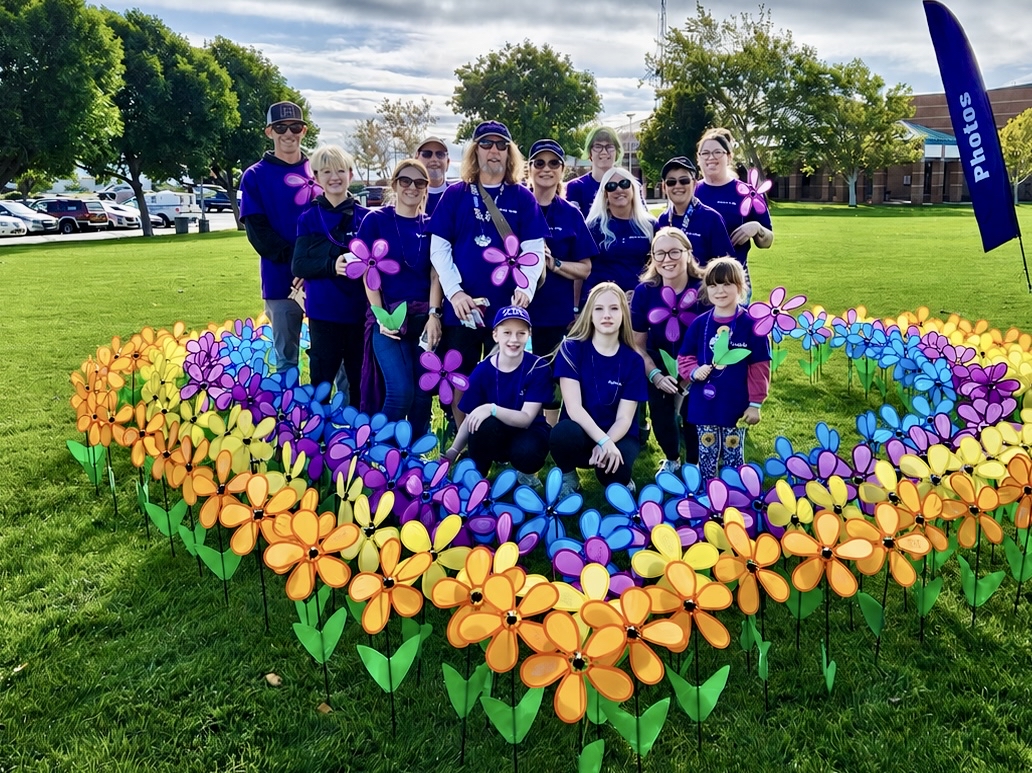
The team didn't start with that name. It began as "The Bullingtons" - Gary and his family, doing the Walk to End Alzheimer's because Gary's mother, Sylvia, was living with the disease. Over time, Gary's siblings joined in with families of their own, and the team took the name it carries today: Sylvia's Kids.
It's grown into something bigger than a fundraising team. It's a reunion. This year, nine family members are walking, including four grandchildren; two more couldn't make it. Gary's siblings (Cindy, Janice, and Charlene among them) bring their own branches of the family tree, and every one of them, for one day a year, comes back to Sylvia.
"It's a way to keep her memory alive," Gary says. "And a reason to keep showing up for each other."
The shirts have changed over the years, from simple black and white to a full-color photo of Sylvia on purple, making them one of the first purple-shirted teams at their Walk. The pins and hand-designed shirts they used to collect are gone now, a casualty of COVID-era changes. But the reason they keep coming back hasn't changed at all.
What Sylvia's Family Learned the Hard Way
Gary's mother started showing signs of Alzheimer's in her early 60s. It was Gary's wife, a physical therapist, who first noticed something was wrong and pushed for testing.
The early signs were the kind that are easy to miss until you look back on them: paperwork that kept turning up hidden, furniture that had been quietly rearranged overnight, and increasingly, moments of fear - Sylvia was convinced people were on her neighbor's roof.
She was living alone at the time. Gary and his wife checked on her every single day after work. Then came the moment that changed everything: Sylvia had turned on the stove burners to warm the house, and the house filled with gas. Gary got there just in time.The family removed the knobs from her stove that day. They also started calling relatives and searching for a place where Sylvia could be safe.
She spent six and a half years in a private group home in Phoenix, far longer than most families get, and Gary knows it. The owner, a nurse, involved Sylvia in preparing every meal. Something about the structure and the company changed her. The hallucinations that had frightened her for months stopped completely the day she moved out of her own home and into a place where she wasn't alone.
Sylvia passed away at 77.
What Gary Wants Other Caregivers to Know
Gary and his brother Bill have both noticed signs in themselves that give them pause. None of the seven siblings have chosen to be tested. Their reasoning is their own - they'd rather not carry the anxiety of knowing, and as Gary puts it, they trust that time will unfold the way it's meant to.
What Gary is certain about is what he learned caring for his mother, and he shares it freely with anyone walking a similar road:
- Give the caregiver relief. The person providing daily care can become a kind of victim themselves — especially when nighttime wandering steals their sleep, too. Backup matters.
- Don't argue. Enter their world instead. Correcting someone with dementia usually just creates anxiety. Going along with them is kinder, and it works better.
- Include them in the conversation. Even when it's hard, talk to them — not about them like they're not in the room.
- Use touch. A hand held, a hand on the shoulder — small ways of saying I see you, you're not alone.
- Never leave them sitting by themselves. Most falls happen when no one's watching.
- Savor the clear moments. They may not come again.
- Don't underestimate socialization. Gary points to his neighbor Polly, who came off portable oxygen after she started playing pickleball regularly. Connection changes people.
The Walk Goes On
Sylvia's Kids has walked in Prescott for a quarter century now, after earlier years at Village of Oak Creek. Every year, they raise around $20,000 for a cause that touches nearly every family eventually.
For perspective, the top-fundraising team at the Prescott Walk now brings in roughly $27,000 to $28,000 a year, up from about $12,000 when Gary first started, built by fundraising all twelve months of the year, not just in the weeks before Walk day.
That's the thing Gary most wants people to remember: donations don't stop mattering after Walk day. The Alzheimer's Association accepts gifts through the end of the year; every dollar still counts toward research, caregiver support, and a future where teams like Sylvia's Kids might not need to keep walking at all.
How You Can Help
Sylvia's story is one of millions. Alzheimer's doesn't just take memory, it reshapes entire families, the way it reshaped Gary's. But it also, sometimes, brings people together in ways nothing else could.
You don't have to have 25 years of history to make a difference this Walk season.
Join a team, start your own, or make a gift today at act.alz.org/dswwalks; and if you can't make it to a Walk in person, remember: like Sylvia's Kids, you can still show up, wherever you are.
Because until there's a cure, every step, and every gift, keeps the promise moving forward.