

Be a Part of the Fight to End Alzheimer's
Be a Part of the Fight to End Alzheimer's
The millions of people impacted by Alzheimer's disease need your help. Your generosity can help us provide care and support to these facing the challenges of Alzheimer's, protect brain health and advance global research. Please make a gift today.
Donate NowAfter being diagnosed with Alzheimer's, Dennis found he qualified for Lecanemab. Dennis shares how he travels to Sacramento for treatment. His hope is that the funds he raises for Walk to End Alzheimer’s will help find a cure.
Dennis spent 30 years in the fashion industry before becoming a substance abuse counselor and retiring in Rio Vista with his wife. After being diagnosed with Alzheimer’s, he now travels to Sacramento twice a month for treatment to slow the disease’s progression. In the hopes of finding a cure, Dennis supports Walk to End Alzheimer’s in Solano County and has raised thousands to help fund research toward a cure.
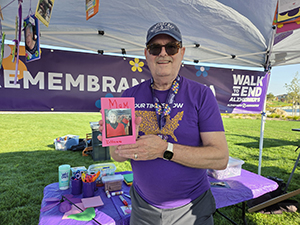 From fashion to counseling
Dennis spent roughly the first 30 years of his adult life in Southern California, working his way up through the fashion industry. Starting his career as a salesperson for a clothing shop before being promoted first to store manager and then to regional manager. Eventually he became the person who decides which clothing items his company would be selling in their stores.
When his company was sold, Dennis moved into the wholesale market, specifically for the surf and skate industry. Later, he and two other people became responsible for Coca-Cola brand clothing. Dennis was part of the team that helped create the artwork that customers would find on t-shirts and sweatshirts nationwide.
After 30 years in the fashion industry, Dennis woke up one day and decided he’d like to help people instead. He quit his job, enrolled in college and became a counselor for people who had substance abuse problems. Dennis worked in a local hospital for several years until he retired.
Dennis and his wife Cindy found a quiet little area off the Sacramento River and decided to live out their golden years at a senior community in Rio Vista.
Telltale signals
Prior to his retirement, Dennis noticed he was forgetting things like his water bottle or his wallet. Other times he’d forget what he was talking about mid conversation. “Looking back now, those were the telltale signals of what was to come,” said Dennis. “I didn’t think about [Alzheimer’s] at the time. My mother and grandmother died of Alzheimer’s. I didn’t relate it to myself at all.”
After moving to Rio Vista, Dennis’ forgetfulness only got worse. He was losing his place in conversations more frequently and was having trouble using his computer, something he’d excelled at only a few years prior. “Along with that came frustration,” said Dennis. “I would get agitated, irritable, a little pissy. Sometimes that would lead to anger, being upset and mad.”
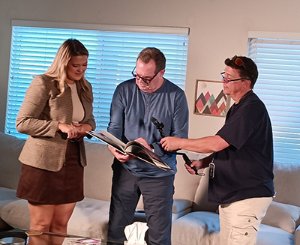 Alzheimer’s diagnosis
When the time came for Dennis to see a doctor, Cindy was right by his side. Prior to her retirement, Cindy had been a hospital case manager. She was able to help Dennis navigate the medical system to ensure the best care.
After seeing a neurologist, Dennis received an MRI where they found amyloid plaque on his brain.
Qualifying for treatment
Fortunately there is exciting progress in Alzheimer’s and dementia research that is creating promising new treatments for people living with the disease. The U.S. Food and Drug Administration (FDA) has approved medications that change disease progression in people living with Alzheimer’s.
Dennis is currently receiving Lecanemab (Leqembi®), an anti-amyloid antibody intravenous (IV) infusion therapy that is administered every two weeks. “I found out I qualified for infusions,” said Dennis who recently received his 20th infusion. “I know Leqembi slows [disease progression] down. I found I’m not having frustration on my laptop like I used to. I’m just able to do things better.”
These infusions are so important to Cindy and Dennis that they’re willing to make the hour-long trip to Sacramento twice a month. Cindy was able to find them affordable rides to and from the hospital, which means they don’t have to worry about driving themselves. Dennis said, “Sometimes her ability to get these things accomplished has been amazing.”
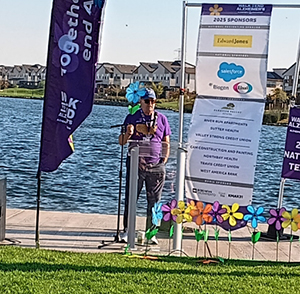 Holding the blue flower
Despite his family connection to the disease, which now includes his sister, Dennis didn’t contact the Alzheimer’s Association until his own diagnosis. When he heard about Walk to End Alzheimer’s in Solano County, he reached out for help to create a team.
During the phone call he shared his story with the Walk Manager who asked him on the spot if he’d like to stand on stage during the ceremony and hold a blue flower, representing people living with the disease. Dennis proudly held the blue flower during the ceremony in 2024 and again in 2025.
“You meet other people [on Walk day] with the disease,” said Dennis. “You have family and friends of people with the disease, and you come together for the same purpose. I think the interaction between others is huge.”
Finding a cure
Funds raised at Walk to End Alzheimer’s fuel the mission of the Alzheimer’s Association and help advance critical care, support and research. Research that Dennis hopes will one day result in a cure. In two years, Dennis has raised more than $10,000 for Walk. “I had friends from high school who were writing checks,” said Dennis. “People from my career, friends and family. I just asked. I was blown away.”
Dennis encourages others to get involved with Walk and make a donation. “Help donate money for the purpose of curing Alzheimer’s,” said Dennis. “The cure could be far down the road but we need the finance behind in order to find a cure for this disease. We need to support that.”
It’s not too late to support Walk to End Alzheimer’s. Fundraising continues until December 31, 2025. Visit alz.org/walk to support a Walk near you.