

Double Your Impact on Millions of Lives
Double Your Impact on Millions of Lives
Now is the time to do more in the fight against Alzheimer’s and all other dementia. Give by July 20 and your gift can be matched, up to $35,000, to fund research that is helping protect brain health and provide care and support.
Donate NowThe wildfire season is already underway in New Mexico, and research has shown that wildfire smoke poses unique risks to the cognitive health of residents. The Alzheimer's Association has tips on how to both understand and minimize the risks posed by wildfire smoke.
Brain health and wildfire smoke
Another season of wildfires has begun across New Mexico and much of North America, and the Alzheimer's Association offers a reminder about the unique risks that wildfire smoke poses to our cognitive health.
A 10-year research study of more than 1.2 million people aged 60 and older, none of whom had been diagnosed with dementia at the beginning of the study, revealed an increased risk of dementia diagnosis due to wildfire smoke exposure, even with less exposure than to other air pollution sources.
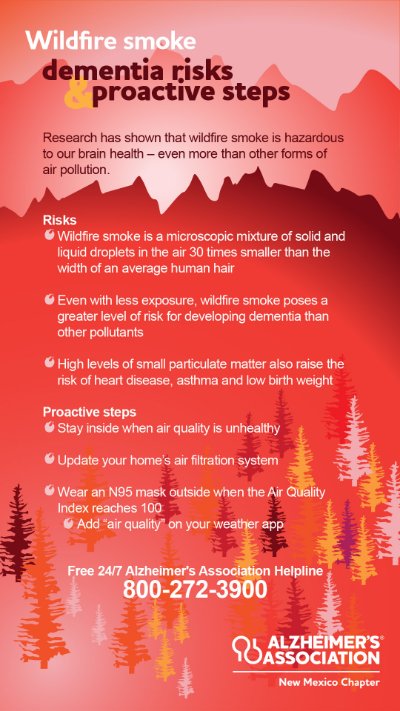 “Wildfire smoke may be more hazardous because it is produced at higher temperatures and contains a greater concentration of toxic chemicals,” said Donald Smithburg, executive director of the Alzheimer’s Association of New Mexico. “On average, the particulate matter is smaller than that from other sources – a microscopic mixture of solid and liquid droplets in the air that are 30 times smaller than the width of an average human hair – making it easier to absorb in the body leading to multiple health risks, including higher risk of heart disease, asthma and low birth weight.”
Wildfire smoke exposure increasing
Exposure to wildfires and associated smoke is on the rise across the U.S. According to data from the Stanford Environmental Change and Human Outcomes Lab, the average person in the U.S. experienced about 66% more fine particle pollution from smoke in 2023 than during the previous record year (2021).
Wildfire smoke accounts for up to one-quarter of all fine particle pollution across the U.S., and up to half in parts of the West.
Tips to cope with wildfire smoke
The Alzheimer's Association has several suggestions for people to better cope with the wildfire smoke that has become a more consistent part of our lives.
- Try to limit time outdoors when smoke is at its worst
- If you need to spend time outdoors, consider wearing an N95 mask
- Get a high-efficiency furnace filter (MERV 9-12 or 13-16) that can remove most of the fine particles in the wildfire smoke to keep it from entering your home environment
To learn more about the information, programs or services offered at no charge by the Alzheimer's Association, go to alz.org or call the Association’s free Helpline, staffed 24/7 by trained professionals, at 800-272-3900.