

Make Twice the Impact Right Now
Make Twice the Impact Right Now
Our Autumn 2x Match Challenge is happening right now. Until midnight on Oct. 12, your gift can go twice as far to advance research, promote brain health and help provide care and support for those impacted by Alzheimer’s.
Donate NowDr. Teresa Sigala, an internal medicine physician with Community Health Partners, became a caregiver for her mother with Alzheimer’s, transforming how she supports her patients. Now she encourages awareness especially in the Hispanic community.
Dr. Teresa Sigala, an internal medicine physician for Community Health Partners, became a caregiver for her mother after she was diagnosed with Alzheimer’s. Through her personal experience as a caregiver, Dr. Sigala changed the way she helps and provides resources to her patients. Dr. Sigala and her company, this year’s Presenting Sponsor, Community Health Systems, actively participate in Walk to End Alzheimer’s -Fresno-Madera and encourage awareness, especially in the Hispanic community.
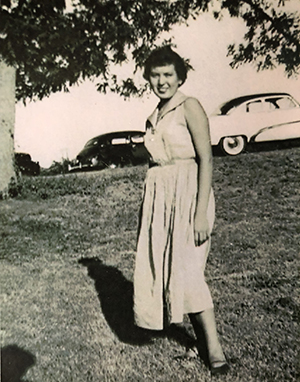 An adventurer
Norberta Sigala was a vibrant woman who loved life’s adventures. A first generation Mexican American, she was known to drop everything at a moment’s notice to go on a trip, try new and exciting foods and live the best life she could. Of course, family always came first. As a mother of six, she spent her children’s early years as a stay-at-home mom. When her youngest started middle school, she went back to work.
It was an unfortunate surprise when, in her mid 70s, Norberta began to show the signs of dementia. “I was living in New Mexico when my sister said, ‘Something is wrong with [Mom’s] memory,’” said Dr. Teresa Sigala, one of Norberta’s daughters. “I came home for the holidays but didn’t see anything out of the ordinary.”
However, after Norberta was stopped by the Transportation Security Administration (TSA) on a return trip from Hawaii, Dr. Sigala realized her mom needed to see a doctor. “We were coming back through the TSA checkpoint at the airport in Kauai when they opened Mom’s suitcase, and it was a disaster.
“We had to put every little shampoo bottle in those baggies, seal them up and basically repack her luggage so that it would pass through the TSA check point. At that point I knew that was really the for sure sign [of Alzheimer’s].”
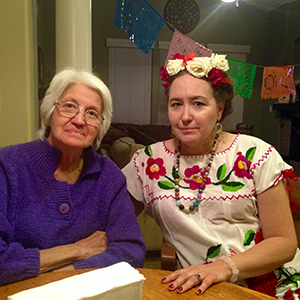 Moving in with Mom
Dr. Sigala and her sister took Norberta to her primary care physician where her doctor performed a mini mental status exam. “She did terribly,” said Dr. Sigala. “He was able to diagnosis her with Alzheimer’s and start medication for her. Our family was able to start making plans.”
Luckily, Norberta had a pension and health insurance from her job. Dr. Sigala decided to move back to Fresno to be her mother’s caregiver. “Mom never wanted to go into any type of facility,” said Dr. Sigala. “We made it possible for her to live in her home, which is what she wanted.”
Norberta died in her home in 2018 at the age of 86. “She was not someone who was chronically ill,” said Dr. Sigala. “She would have lived into her mid 90s before anything else would have slowed her down. I felt that [an Alzheimer’s diagnosis] was particularly cruel.”
Diagnosing her patients
As the prevalence of Alzheimer’s disease increases, so does the need for more members of the paid workforce to be knowledgeable and skillful about working with different populations of people living with dementia, as well as with their families.
Fifty-five percent of primary care physicians (PCPs) caring for people living with Alzheimer’s report there are not enough dementia care specialists in their communities. Half of PCPs reported that they do not feel adequately prepared to care for individuals with Alzheimer’s and other dementias. More than half of primary care physicians say there aren’t enough dementia specialist in their communities.
Currently, Dr. Sigala is a doctor of internal medicine at Community Health Systems (CHS), a health care system based out of Fresno. Additionally, she works on a research program through University California San Francisco (UCSF) that works on diagnosing people in the early stages in a primary care setting.
Prior to her mother’s diagnosis, Dr. Sigala was aware of the disease and had seen it in her patients. Thinking back to her time in school, the recommendation was to do a mini mental exam and give the patient their score. However, it was always unclear what to do next.
Now that she has had the personal experience of caring for her own mother, Dr. Sigala has found new confidence in helping her patients going through a similar experience. “When my mom got diagnosed, [I thought], ‘What difference does it make anyway? We’d care for her the same,’” said Dr. Sigala. “That was before I moved in with her and was a big part of her care team. Then I found out first-hand what it’s like to be a caregiver and how much I needed support.
“Now I’m not afraid to bring up [dementia with my patients]. I know what to do now in terms of, what are the next steps [after a diagnosis]? What are the labs I need to order? Do I need to order an MRI? If I have questions, who do I ask? Primary care [doctors] shy away from that because it’s not clear how to diagnose someone with Alzheimer’s vs. other types of dementia.
“Were in a business where we have a certain number of appointments. It’s very labor intensive; it takes a lot of time to sit down with a patient and answer questions with the family. It’s really important for doctors to be trained. This is why I’m part of this research project. It gives practitioners the tools they need to diagnose these patients.”
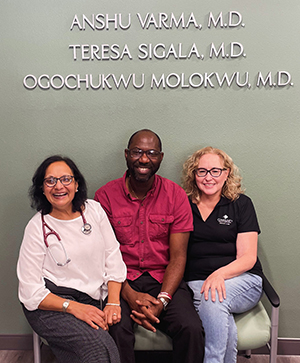 An increase in awareness
According to the Alzheimer’s Association, Hispanic Americans are more likely to believe that significant loss of memory or cognitive abilities is a “normal part of aging” – with 57% of those surveyed believing this to be true. Hispanic Americans are twice as likely as Whites to say they would not see a doctor if experiencing thinking or memory problems. One in five Hispanic Americans (20%) say they would feel insulted if a doctor suggested a cognitive assessment.
However, Dr. Sigala isn’t seeing this in her practice, and she believes this is due to an increase in awareness about the disease. “People are coming to me and say, ‘You know I’m having some probs with memory,’” said Dr. Sigala. “I’ll talk to them about our research project and ask if they want to participate.
“We set up appointments to talk about getting a better [medical] history, discussing symptoms and changes and coming up with a plan to confirm the diagnosis, getting bio marker testing, getting a second opinion and getting help with cases.
“I think that people are becoming more aware of treatments and different things are in the pipeline and they’re not afraid to deny it anymore. They are seeking help and guidance. It wasn’t like that 10 years ago. People shouldn’t be afraid to go to their doctor.”
Learning about the Association
Despite having both a personal and professional connection with dementia, Dr. Sigala didn’t know about the Alzheimer’s Association until she was approached by someone from the organization.
“I had no idea what [the Alzheimer’s Association was],” said Dr. Sigala. “I had no idea how helpful it could be. It’s been a great resource. When I do talks or different presentations, it’s been a good resource, and I send patients there. I’m really making good use of it, and I can’t imagine if it wasn’t in existence.”
At the event
The Alzheimer’s Association Walk to End Alzheimer’s® is the world’s largest fundraiser for Alzheimer’s care, support and research. This inspiring event calls on participants of all ages and abilities to join the fight against the disease. The funds raised for Walk fuel the mission of the Association and help advance critical care, support and research.
“I can’t think of one person that hasn’t been affected by this disease,” said Dr. Sigala. “This [cause] is so important, and it needs to be more of a priority than it is. I think people need to get fired up about it. We need to find ways to help patients with Alzheimer’s feel they are safe and have caregivers be supported so they can live the best life in a safe and comforting environment.
“It’s very comforting to know the Alzheimer’s Association supports families and health care professionals. They’re able to get the visibility that this disease needs in order to raise funds. The part I like the most [on Walk day] is when you get there, you see team members, and everyone is all excited. We get together and the speakers talk about why we’re all there. It’s nice to know other people care as much.”
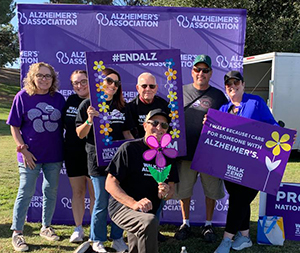 Presenting sponsor
When Dr. Sigala began working for Community Health Partners (CHP) they asked her if she’d be interested in participating in Walk to End Alzheimer’s – Fresno-Madera and she said, “Of course!” While the health system has previously been a sponsor for Walk, 2025 marks their first year as the Presenting Sponsor for the event.
“It’s a good fit because the community has really made big attempts to improve health care for people in general. They’re going out of their way to really attack these specific problems such as health inequality. To me the Alzheimer’s Association is a very committed organization, committed to improve the lives of many people not just the people with Alzheimer’s. It dove tails in and is a natural fit.”
At the event, CHP will have a table for anyone from the community to come and speak with CHS staff, ask their questions and find more information. In addition to being a sponsor for Walk, CHP has also started their own Walk team. Coworkers, friends and family are encouraged to sign up, raise funds and join them on Walk day.
“We’ve invited other offices to participate,” said Dr. Sigala. “It’s becoming bigger this year than last year and hopefully it will continue to grow. We have flyers in our waiting room asking them to participate in Walk. It’s also being talked about more on the webpage.”
As of the writing of this blog, Community Health System is one of the top teams for the event in Fresno, having raised more than $3,400.
Completely worth it
Looking back on her experience with her own mother, Dr. Sigala says she wouldn’t change a thing. “[Alzheimer’s] was really terrible,” said Dr. Sigala. “It affected me, and my family. I don’t want anybody else to have to go through that. I know what it took for a family to come together to care for her. When you go through that you develop some empathy, you have the ability to help people see things differently.
“In the end, it was completely worth it. You just have to do your best. It doesn’t show weakness to be able to reach out to help from other family members, or from the Alzheimer’s Association. It’s going to be worth it in the end, and you’re going be able to look back and say, ‘Wow. That was hard and I did it.’”
Join Dr. Sigala and her team, Community Health System Team, at Walk to End Alzheimer’s – Fresno-Madera on October 18 at Woodward Park. Not in Fresno? Find a Walk near you at alz.org/Walk
For more information on Alzheimer’s in the Hispanic community, visit alz.org/hispanicamericans.