

Make Twice the Impact Right Now
Make Twice the Impact Right Now
Our Autumn 2x Match Challenge is happening right now. Until midnight on Oct. 12, your gift can go twice as far to advance research, promote brain health and help provide care and support for those impacted by Alzheimer’s.
Donate NowSheila Cunneen was a strong, independent woman whose life was changed by Alzheimer’s, prompting her son David and niece Laura to become her legal conservators. Worried for his own health, David adopted a healthier lifestyle and joined Walk to End Alzheimer’s to raise awareness and hopes to find a cure.
Sheila Cunnneen was a strong, independent woman whose life was upended by Alzheimer’s. As the disease progressed, her son David and his cousin Laura took legal steps to care for her as her conservators. Inspired by her journey and his family’s history with the disease, David changed his lifestyle to reduce his own risk factors and became involved in the Alzheimer’s Association Walk to End Alzheimer’s®, helping raise awareness and hopes to find a cure.
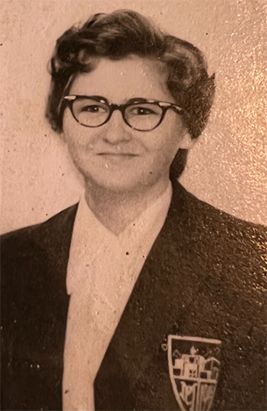 An independent woman
Sheila Cunnneen had always been a strong independent woman who enjoyed traveling, loved to bake, volunteered for different organizations and was an avid walker. When her youngest son, David, was five, she got a divorce and decided she didn’t want to remarry. Instead, she worked two jobs to care for her children and later her grandchildren.
“She liked wine and cats,” said David. “She was content after she retired with her vision of home and travel. She made a plan that went sideways with [Alzheimer’s], but she was a strong woman. She loved fiercely…she was Mom.”
Missing the signs
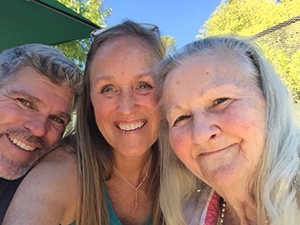
In the late 2010s David was living in Humboldt County, roughly 250 miles from his mother’s home in Petaluma. Because he lived so far from her and didn’t see her daily, he was unaware of any cognitive issue she might be having. Luckily, David’s cousin, Laura, who is like a sister to David, lived closed to Sheila and when it became obvious to Laura that something was wrong, she called David.
“I was up here, and my cousins would notice things,” said David. “She was forgetting words, couldn’t remember recipes, couldn’t participate in a conversation and she was oblivious. Things that you would think there would be muscle memory for.”
Disease progressed quickly
By the time Sheila was diagnosed with Alzheimer’s, the disease was so advanced she was unable to safely make legal and financial decisions on her own. David and Laura went to court to get conservatorship of Sheila in order to help pay her bills and make medical decisions on her behalf.
The Alzheimer’s Association® encourages people living with the disease to get diagnosed early. Legal plans are especially vital for a person diagnosed with dementia. The sooner these plans are put in place, the more likely it is that the person living with dementia will be able to participate in the process.
“Falling behind on [financial] things happened so quickly,” said David. “We had to go through a court process to access her [Social Security benefits] and bank accounts.”
Eventually, Sheila moved to a care setting in Vallejo. She lived there until her death in November 2024.
 Lifestyle changes
Unfortunately for David, Sheila isn’t the only family member to receive an Alzheimer’s diagnosis. Five of Sheila’s siblings have or had Alzheimer’s, which makes David concerned for his future.
While family history is not necessary for an individual to develop Alzheimer’s, research shows that those who have a parent or sibling living with Alzheimer’s are more likely to develop the disease than those who do not have a first-degree relative with Alzheimer’s.
Taking his health into his own hands, David made lifestyle changes in the hopes of reducing his risk of cognitive decline. Recently, the Alzheimer’s Association announced the results from the U.S. POINTER clinical trial. The trial found that participants experienced cognitive improvement regardless of sex, ethnicity, genetic risk (apolipoprotein-e4) or heart health status.
Like David they made changes to their lifestyle, including diet and exercise. This is the “recipe” they followed:
- Physical exercise: 30-35 minutes of moderate-to-intense aerobic activity four times a week, plus strength and flexibility exercises twice a week.
- Cognitive exercise: Computer-based brain training program three times a week for 30 minutes, plus regular engagement in other intellectually challenging and social activities.
- Nutrition: Adherence to the MIND diet, which emphasizes dark leafy greens, berries, nuts, whole grains, olive oil and fish, and limits sugar and unhealthy fats.
- Health monitoring: Regular check-ins on blood pressure, weight and lab results.
“My diet has changed,” said David. “I was a drinker, and I’ve cut back on that,” said David. “I’m always healthy, I’m a hiker, I kayak and bike ride. I eat fresh foods, vegetables and protein. I’m very cognizant of what I put in my body and my lifestyle. I want to make my mind and body last as long as possible.”
Finding Walk to End Alzheimer’s
Despite his lifestyle changes, David ultimately hopes there will be a cure. Currently, the Alzheimer’s Association Walk to End Alzheimer’s® is the world’s largest fundraiser for Alzheimer’s care, support and research. David hopes that the money raised for research will help find a cure.
David first learned of Walk to End Alzheimer’s a few years before his mother’s death. Laura wanted David to come and participate in her local walk in Napa. Instead, David found a Walk in Humboldt County. David also learned that his company, Pierson Building Center, had been a long-time sponsor of Walk to End Alzheimer’s.
Join the co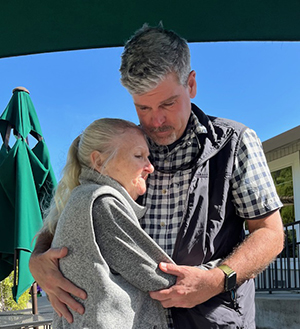 mmittee
But walking wasn’t enough, David wanted to do more to help end this disease and find a cure, so he joined the Walk Committee. “I saw a link [to Walk], followed it and then joined the committee,” said David. “This is something that I can do to pay it forward. I’m afraid of Alzheimer’s, anything I can do to promote [Walk], education, awareness, research – I’m all on board.”
As a Committee Member, David is asked to attend meetings once a month throughout the year. As the event day gets closer, there are a few extra meetings committee members will attend. David likes that members can be as involved as they want to be with some committee members promoting the Walk year-round.
David specifically helps with the logistics of the event. “I help set up on the day before,” said David. “Setting up banners and the event. I’m a laborer. The day of the walk is really fun, setting up and being a part of something that is much bigger than me.
“I wish it was the kind of event where there were 10,000 people [here]. I’d love to see this blow up, and that’s what it’s going to take. Seeing everyone involved in that community who are just there to help. The camaraderie of it coming together for such a good cause.”
You can join David and his team, Pierson Building Center Team, at Walk to End Alzheimer’s – Humboldt County on October 11 in Eureka. Not in Humboldt County? Visit alz.org/walk to find a walk near you.