

Triple Your Impact This Holiday Season
Triple Your Impact This Holiday Season
Celebrate the holidays with a year-end gift that can go 3x as far to help provide care and support to the millions affected by Alzheimer's disease, and to advance critical research. But please hurry — this 3x Match Challenge ends soon.
Donate Now“I’ve realized that there are so many ways that we can advocate for people with Alzheimer’s."
In early March, Taylor Dry of Irmo took time to attend her first Alzheimer’s Association State House Advocacy Day. Despite severe weather and a slam-packed lobby, she joined advocates from across the state to ask her legislators to stand up for the needs of South Carolina families facing Alzheimer’s or another dementia.
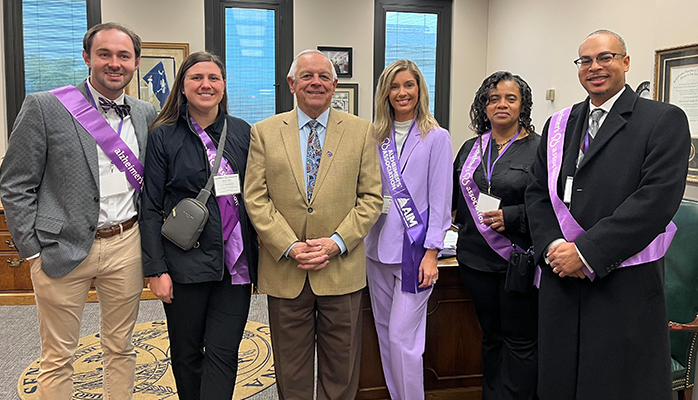
“I had some really good teachers and mentors that highlighted how important my job can be for helping dementia patients,” said Taylor. “What kind of memory strategies can we put in place? What kind of education can I give to family members of patients who are going home? If their choice is to age in place, how can we make sure that they’re going to be as safe as possible?”
Her first steps into advocacy truly started at her own workplace, where she recognized a need among her patients and worked to create a solution.
It all started with a little time.
Orientation to place and time is an important part of Taylor’s speech therapy work with patients.
“I have a hard time reading analog clocks, so I knew it must get harder and harder for people with dementia,” said Taylor. “I’ve had patients who would wake up at 2 o’clock in the morning thinking that it was the afternoon. They’d get up and get dressed, thinking that they had missed the whole day.”
And that’s when she had a light bulb moment.
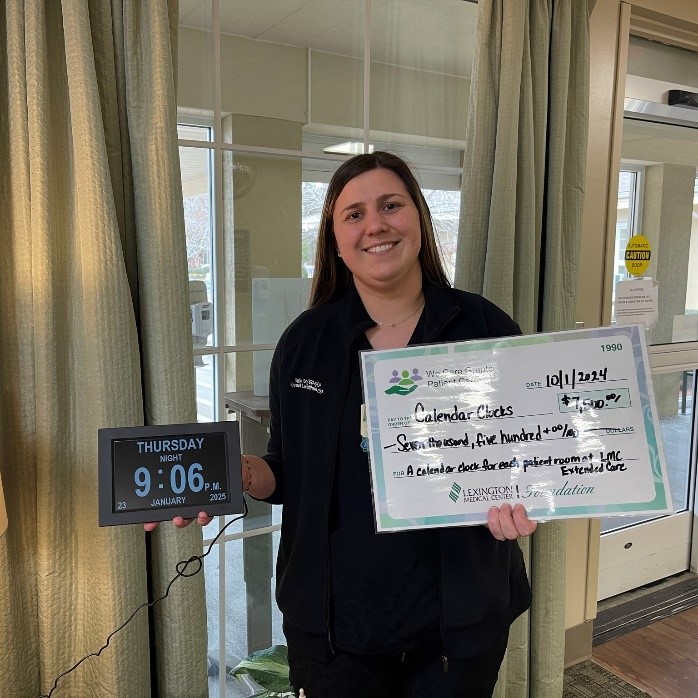
“I knew that these calendar clocks existed. They have the time, the date, the year, the day of the week, whether it’s morning, afternoon or night,” she said. “I took the idea to my boss, and she gave me the green light to apply for a grant.”
As an employee of the Lexington Medical Center, she had a unique opportunity to submit her idea to the LMC Foundation as a We Care Internal Grant. Thanks to Taylor’s idea and initiative, every patient room at LMC Extended Care now has a calendar clock.

“A lot of our dementia patients have started to learn that if someone asks what day it is, they can just look at the clock to get the answer,” Taylor said. “I had one patient who told me it made a world of difference to wake up and know what day it is and what time it is. She said, ‘I woke up, and I thanked God because I didn’t have to try to read the clock.’”
Taylor is also passionate about facilitating effective and caring communication with her dementia patients. Since completing the clock project, she has been asked to help create an in-service for her
department colleagues on interacting with patients who have impaired cognition. She has also taken the first steps to become a Community Educator volunteer with the Alzheimer’s Association.
“There’s so much education out there now," Taylor said. "I’m always asking myself, ‘What’s the best way to interact with this individual with dementia?’ Because we can always learn.”
__________________________________________________________________
While Taylor is advocating for dementia patients in the healthcare space, there’s something that everyone can do to get more involved and more informed. All it takes is a little time.
Do you have a bright idea like Taylor?
- Check out local grant opportunities in your community.
- In the Midlands, the Lexington Medical Center Foundation offer opportunities for community partners that enhance the health and wellness of community members. To learn more, contact the Foundation at 803.791.2540.
- This is also a great time to learn about a separate state-funded grant opportunity through the Alzheimer’s Resource Coordination Center at the SC Department on Aging, which offers seed grants for community respite programs (including day programs at faith communities), educational programs (including programs for individuals with early-stage dementia) and innovation grant that address safety and accessibility of programs. The application process is currently open, with a deadline of April 11, 2025.
Do you know of a group that would love to deepen their understanding of Alzheimer’s and dementia?
- You might be just the person who can spark change with one quick conversation. Consider approaching leadership at your workplace, faith community, or neighborhood group about requesting a free presentation from the Alzheimer’s Association. Our useful topics range from a brief awareness presentation to in-depth classes on the warning signs or effective communication strategies. View our offerings and request a group presentation.
Do you have a passion for sharing information and resources to help others on the dementia journey?
- If you're looking for a volunteer opportunity that helps educate local communities, providing education through public speaking might be a good fit for you. Our Community Educators give presentations on essential care and support topics, work with community partners and connect people with the resources they need at the Alzheimer's Association. Sign up to volunteer as a Community Educator.
Would you like to learn about advocacy opportunities with the Alzheimer’s Association?
- It's easy to get started. Get timely alerts and tools for contacting your legislators on key issues by texting ALZSC to 1.888.438.0144.