

Be a Part of the Fight to End Alzheimer's
Be a Part of the Fight to End Alzheimer's
The millions of people impacted by Alzheimer's disease need your help. Your generosity can help us provide care and support to these facing the challenges of Alzheimer's, protect brain health and advance global research. Please make a gift today.
Donate NowTim Williams is determined to do his part to end Alzheimer's, one raffle ticket and one research study at a time.
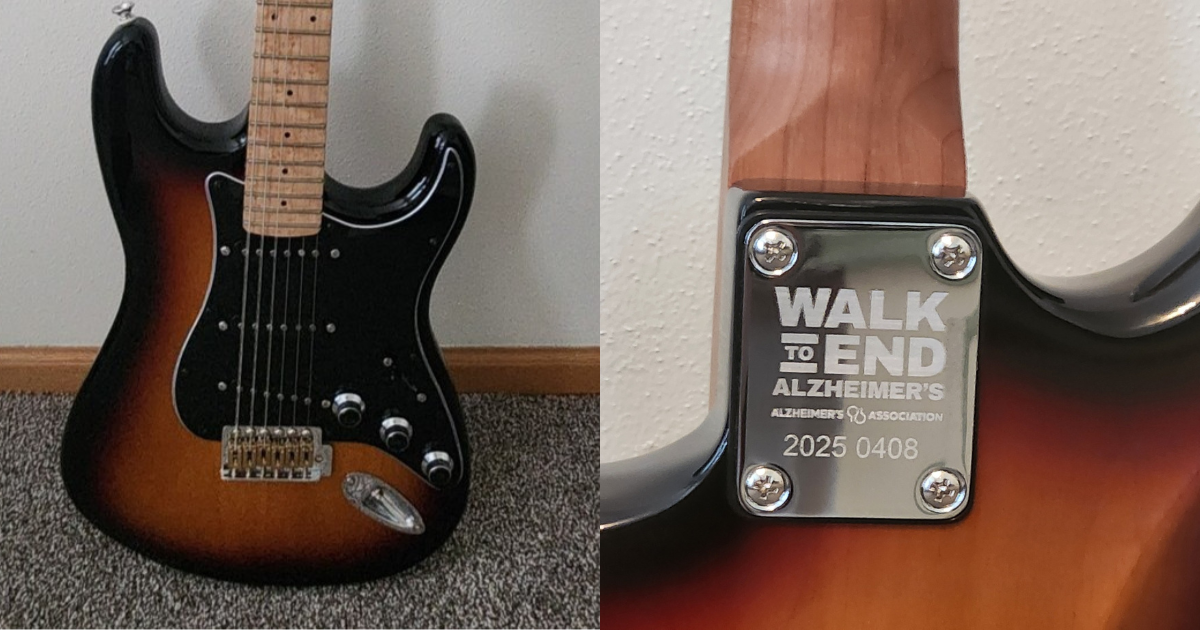
A full mission volunteer with the Alzheimer’s Association Wisconsin Chapter, Tim lives in Burlington and dedicates his time to fundraising, advocacy, and research. This September, as he’s done for the past four years, he’s raffling off a custom-made electric guitar (donated by Bitterroot Guitars)—a one-of-a-kind instrument and piece of art designed to honor his loved ones and support the fight against the disease that changed his life.
The guitar is stunning: a sunburst finish, a neck carved from North American Black Cherry Wood, and specially, a Walk to End Alzheimer’s logo on the back of the neck. Anyone across Wisconsin can enter to win it, because even though the winner will be chosen and announced at the Walk to End Alzheimer's - Walworth County on Saturday, September 20, the winner need not be present. Raffle tickets are available now and can be purchased through Tim's Walk fundraising page or through Tim directly. They are $35 each, two for $50, or five for $100, and all proceeds benefit the Alzheimer’s Association Wisconsin Chapter. But the guitar is just one part of Tim’s mission.
In 2008, Tim lost his father to Alzheimer’s disease. The following year, he got involved with the cause. In 2019, his world changed again when his sister Beth was diagnosed with Alzheimer’s at the age of 70. She passed away in late 2023.
“When Beth was diagnosed, I prayed to God,” Tim says. “I said, ‘Put something in front of me. How do I stay ahead of this?’”
That prayer led Tim straight into research. He enrolled in the AHEAD Study, a groundbreaking international clinical trial aimed at preventing memory loss by treating the disease before symptoms appear.
The study, which tests the investigational drug lecanemab, looks at whether removing amyloid plaque from the brain can slow or prevent Alzheimer’s. At first, Tim didn’t qualify, as his scans showed no elevated amyloid. But after Beth’s passing, he screened again. This time, plaque was present, so he enrolled as one of only 1,200 study participants worldwide.
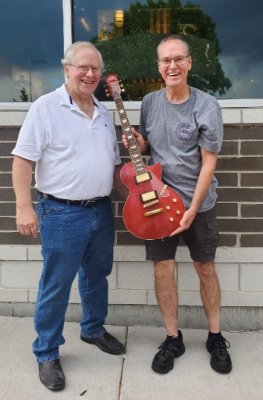 Tim received his first infusion of either lecanemab or a placebo in August 2024. As of August 2025, he has completed 14 infusions with initial side effects, but minimal side effects for the past eight months. He undergoes frequent memory testing, and every 12 weeks, he gets an MRI as part of the trial—volunteering his time, energy, and body to help advance science.
And he’s not stopping there. Tim has also participated in research studies with the Medical College of Wisconsin and in Illinois. His efforts don’t just end with himself. By his count, he’s inspired and encouraged at least 20 friends, family members, and acquaintances to get involved in Alzheimer’s research.
“What if it works?” he says. That simple question fuels his commitment.
Tim and his wife have been married for 48 years, and this year, their nearly one-year-old great-granddaughter will carry the white flower of hope at the Walworth County Walk, symbolizing the first survivor of Alzheimer’s.
She will be too young to remember this moment, but it will be captured in photos and memories: a family fighting back, led by one man who refused to give up.