

Make Twice the Impact Right Now
Make Twice the Impact Right Now
Our Autumn 2x Match Challenge is happening right now. Until midnight on Oct. 12, your gift can go twice as far to advance research, promote brain health and help provide care and support for those impacted by Alzheimer’s.
Donate NowThe typical family caregiver for a loved one living with Alzheimer’s contributes 31 hours of their time per week. Tarra Main of Rio Rancho is not typical. As a “sandwich-generation” caregiver, Main provides care full-time for two children living with autism, as well as her father who has Alzheimer's. On top of that, she somehow makes time to volunteer for the Alzheimer's Association.
“Sandwich generation” caregiver gets squeezed in the middle
Before Tarra Main even knew what a “sandwich generation” caregiver was, she was one. A former accounting professional, Main began transitioning to her role as a caregiver 10 years ago when one of her children was diagnosed with autism at age 3. Unable to find appropriate daycare services, she was able to secure limited funding to serve as home caregiver/community support caregiver for her son and a second child with autism and developmental delays.
“I make it work,” she said.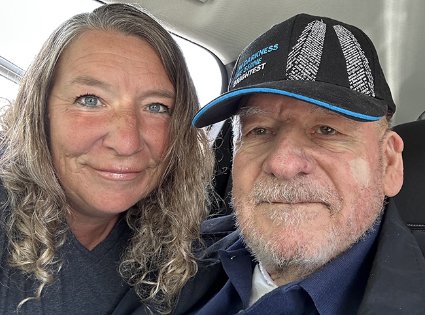
That was before Main’s parents relocated to Rio Rancho in 2021. Any potential relief she might have received from her parents’ presence was quickly dispelled when her dad’s declining cognitive health became too obvious to ignore.
“It took dad some time to agree to getting a diagnosis,” Main said. "I knew something was wrong. There were moments when he’d forget what year it was. And the move here from Chicago was a traumatic change. We finally got a referral to see a neurologist, but it took us over a year to get in to see him.”
Completing the “sandwich”
After her father, Ted, was formally diagnosed with Alzheimer’s two years ago at age 78, Main took on the formal role of sandwich generation caregiver.
“We purchased a home with a bedroom on the first floor for my parents, and my daughter, son and I occupy the upstairs,” Main said. “My dad wants to stay at home and not in a nursing home.” While her 82-year-old mother participates in the care, “she has her limits.”
In her dual caregiving role, Main finds that she is dealing with the issue of independence from both ends of the spectrum.
“I’m teaching my youngest son independence while taking away my dad’s,” she said. Her father’s career as a fire insurance inspector had him on the road continually.
“He loved to drive,” said Main, so as his cognition declined, taking away that privilege has been challenging.
Some of the lessons that Main has learned from caring for her sons have proven useful with her father.
“We use laminated sheets to keep track of days, medications and appointments,” she said. But beyond her dad’s declining memory, the biggest issue is his frustration with the changes.
“He doesn’t remember…and he doesn’t remember that he can’t remember,” she said. “Knowing what I know, I can see the stages (of Alzheimer's progression), and I remind myself that it’s not intentional. He just can’t remember.”
Seeking outside support
Being an around-the-clock caregiver doesn’t leave a lot of time or energy for anything else, but Main has found support through the Alzheimer's Association.
“Before I was connected to the Alzheimer's Association, I thought ‘what can I do…where do I go?’” Since making that connection, she’s found great benefit in support groups where she can talk with and learn from other caregivers who are experiencing situations similar to hers.
“Those are really important,” she said. “Self-care and talking with others going through the same thing.”
Since becoming engaged with support groups, Main has become an outspoken advocate for the Alzheimer's Association, particularly in the area of obtaining needed resources for caregivers.
“I went to the (New Mexico) legislature for Alzheimer's Advocacy Day, and recently went to the Association’s Advocacy Forum in Washington, D.C.,” said Main, where she joined with hundreds of Alzheimer's caregivers like her from around the country to meet with their state’s representatives to talk about the challenges they face and the need for more resources, including funds for research to find a cure.
Main has experience at the Capitol, having served on the state’s Developmental Disability Council, although she acknowledged that getting attention for the care of a child with a disability is less challenging than it is to raise awareness of the needs of adults with dementia.
“Tarra is a powerful voice for the Alzheimer's Association and for other caregivers,” said Tommy Hernandez, Public Policy director for the Alzheimer's Association of New Mexico. “We know that about 25% of all Alzheimer's caregivers are like Tarra, caring for both a parent with dementia as well as one or more children at home under the age of 18. Her energy and passion for this cause – and for her family – are amazing.”
There are 46,000 New Mexicans among 7.2 million Americans living with Alzheimer’s disease. To learn more about the information, programs and services provided at no charge by the Alzheimer's Association, go to alz.org or call the Association’s free bilingual Helpline, staffed 24/7 by trained professionals, at 800-272-3900.