

Make Twice the Impact This World Alzheimer’s Day
Make Twice the Impact This World Alzheimer’s Day
Double your impact during our World Alzheimer’s Day 2x Match Challenge. Your gift before midnight on Sept. 21 can go twice as far to accelerate research and help provide care and support for millions affected by Alzheimer’s.
Donate NowDon’t wait: Couple’s journey through Alzheimer’s
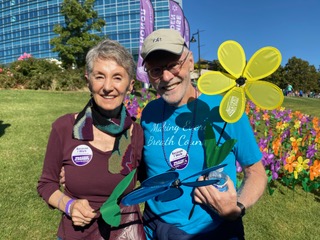
Vicki, a retired professor and traveler, was diagnosed with mixed dementia thanks to her husband Forrest’s support. Together, they share their journey and embrace the mantra “don’t wait” to keep living fully.
Vicki is a retired college professor and avid traveler. After retirement, Vicki began experiencing cognitive issues but was told she was just “getting older.” With the help of her husband Forrest, her strongest advocate, Vicki was diagnosed with mixed dementia, both Alzheimer’s and Lewy body dementia. Vicki and Forrest share their story of the life they lived, the struggles they’ve faced and how they’re following the mantra “don’t wait” as they continue to live life to the fullest.
 A life of helping others
Vicki loves to travel. Her goal is to visit 100 countries and she’s nearly there, having traveled to 89. Her goal was made possible, in part, to having been an educator at a local college for more than 30 years. With her summers free to do as she’d like, she’d often travel alone, with friends, travel groups and often with her husband Forrest.
In her tenure as an educator, Vicki initiated the intercultural communication curriculum in her Stockton based college. For more than 3 decades, she helped young adults unlearn racism and understand cultural differences. This included taking them on field trips to San Francisco as a way to experience a variety of cultural norms.
In her 40s, after she and Forrest were married, the couple went on a trip to Thailand. Vicki stopped by Micronesia, a group of islands in the Northwestern Pacific Ocean, to visit a student she used to teach. There, Vicki fell in love with her student’s daughter and after talking it over with Forrest, asked if the then 9-year-old would want to come stay with them for a semester of schooling in the United States.
For the next 14 years, Vicki and Forrest raised the little girl and her two siblings during the school year, while the children returned to Micronesia during the summers. When the middle child had her own children, she let Vicki and Forrest name them, whom the couple now consider their grandchildren.
When Vicki wasn’t teaching and raising children, she was either working as a ceramic artist or volunteering to feed the homeless. Even when the organization she was volunteering through stopped the program, Vicki called on her friends to come to her house and continued the program for several more years.
Getting a diagnosis
After Vicki retired as a professor, she continued teaching online for five more years. It was during this time she began to notice that she was having a hard time reading and coming up with words. When the time came for her to reconfigure her courses into a different format she became abnormally stressed out about it.
“She was [in the office] cursing,” said Forrest. “I said, ‘Wow it’s going to be stressful. That December she decided to step away. This remarkable, highly intelligent woman was really challenged by the ability to spell and access simple words.”
Taking matters into her own hands, Vicki went to a neurologist and spent the next two years trying to convince the doctor that something was wrong. “The doctor said, ‘Oh it’s just age,’” said Vicki. “I kept coming back saying something was wrong. He’d say, ‘Here do this test on a piece of paper.’ This went on and on, and all this time it kept getting worse.”
It wasn’t until her neurologist was moving his practice to another state that he finally gave in and let Vicki take a more extensive test. After a grueling five-hour neuropsychological exam that left her in tears, Vicki was left without any answers.
“We got a phone call that didn’t confirm Alzheimer’s, but [we were told] she probably needed to stop driving and she definitely has something going on that’s serious,” said Forrest. “The truth about this story is that Vicki knows her body and the doctors don’t believe her message.”
Vicki later went in for a spinal tap procedure where she was officially diagnosed with Alzheimer’s.
 Dismissed
In the midst of getting Vicki a diagnosis, Forrest was diagnosed with idiopathic pulmonary fibrosis, a lung disease that makes it difficult to breathe. “I’ve been able to hold off the disease for 5 years,” said Forrest. “Initially when I [received the diagnosis] Dr. Google said it’s a three-to-five-year life expectancy. I go to pulmonary rehab every week and do a lot of walking because I had to be there for Vicki. We both have terminal diseases.”
Unfortunately for Vicki, things only got worse. She was paired with a new doctor who was less experienced. Upon arriving at the appointment, the couple spent over a half an hour with the nurse answering and re-answering questions. When they finally saw Vicki’s doctor, she was cold and ignored them for 15 minutes while she was on the computer.
“She didn’t ask anything about us,” said Vicki. “We looked at each other, shrugged our shoulders and asked ‘What is this? She’s not even talking to us.’”
While the neurologist did eventually examine Vicki, the doctor continued to be dismissive, wouldn’t answer the couple’s questions and then informed them that she had another appointment and had to go. Forrest said, “The final straw, was as she left, she said, ‘Oh, you have Lewy Body Dementia, you’ll need to get your affairs in order.’ Then she left. We sat there and sobbed.”
Advocating for his wife
While Vicki spent the next several days not sleeping due to stress, Forrest dove into research, learning everything there was to know about Lewy Body Dementia. “Lewy body dementia” (LBD) is a term that includes two related diagnoses: Dementia with Lewy bodies (DLB) and Parkinson’s disease dementia. A person with DLB will develop dementia and other LBD symptoms, including possible changes in movement like a tremor.
After a few days, Forrest was still upset about what he and Vicki experienced at her last appointment. He contacted the head of the department and complained. To his surprise, the VP of quality called him back. They apologized; assured Forrest they would do a peer review on Vicki’s doctor and helped him get connected with a new neurologist.
Their experience with this new doctor was incredible. He took the time to talk to them, answered their questions and helped Vicki get set up for infusions. “We asked about Lewy Body,” said Forrest. “He brought out a black bag, did more tests with her physically in the room and walked with her. He said, ‘She doesn’t have Lewy Body.’ Phew! That was the end of that.”
Vicki was finally able to gain access to infusions and medications. Sadly, they didn’t work for her and instead made her symptoms worse. Ultimately, they took her off of everything.
Another diagnosis
As time went on, Forrest kept the research he did on LBD in the back of his mind, noticing more and more that Vicki was showing symptoms that lined up with this diagnosis. Vicki had hallucinations, stiffness, tremors and delusions, all signs found in someone with LBD. He decided to bring up the possibility of LBD with her doctor.
This time, Vicki’s doctor did a total brain scan, and found she indeed has LBD. They placed her on a few different types of medication which, for now, have reduced some of her worst symptoms. “She’s getting better,” said Forrest. “Her handwriting is larger, her walking pace picked up more, her mood improved and she’s less depressed.”
 Finding Support
In the meantime, Vicky and Forrest have started attending an Alzheimer’s Association® support group designed for people living in the early stages of the disease and their care partners. It is two support groups run concurrently, one for care partners and one for people living with the disease.
“I love everybody in that group,” said Vicki. “People want to share, and they do. I am so grateful when anybody talks about their experience. The group is thoughtful, kind and supportive. We all know what we’re talking about. There is a lot of love in the room.”
Forrest enjoys attending the group for care partners as well. Forrest said, “Sometimes it’s emotional, but for the most part, it’s valuable.” He goes on to share that he knew about the LBD medication because of a fellow support group attendee and has received other pieces of advice from the group.
Living their best life
Currently Vicki and Forrest are continuing to live their best life. “We have a mantra we operate off of – don’t wait,” said Forrest. “We’re packing all the fun in we can right now. We’ve [already] handled all of our end-of-life details.”
Vicki added, “We’ll be in Morocco talking about the next place we want to travel to. Some time it will be ridiculous to think about, but right now it’s not easy to travel but once we get there it’s fun and I’m not depressed. We are doing our best to get as much fun in life as we possibly can.”
Reaching out
As someone living with the disease, Vicki understands the need for information and understanding about her future. She encourages other people in the early stages of the disease to reach out and ask questions from those already experiencing it.
Forrest and Vicki both agree that their biggest recommendation is to find someone who will help advocate for you and your needs. “I would not have what I have now had it not been for Forrest,” said Vicki. “I don’t have the capacity to [advocate for myself] anymore. It’s so important to do this as a team. Ask your close friends to help you read or understand because we can’t do this alone.”
If you have been diagnosed with Alzheimer’s or another dementia, you are not alone. There are people who understand what you are going through, and help is available. There is much you can do in the early stage to cope with the changes ahead. Learn more on our website at alz.org/ihavealz.
For more information on caregiving and caregiver resources please visit alz.org/caregiving.
The Alzheimer’s Association 24/7 Helpline (800.272.3900) is a free service offering support for people living with dementia, caregivers, families and the public. Connect with a live person who can provide information, local resources, crisis assistance and emotional support.