
Be a Part of the Fight to End Alzheimer's
Be a Part of the Fight to End Alzheimer's
The millions of people impacted by Alzheimer's disease need your help. Your generosity can help us provide care and support to these facing the challenges of Alzheimer's, protect brain health and advance global research. Please make a gift today.
Donate NowWhen Bob was diagnosed with vascular dementia during the pandemic, he and his wife Amy moved to the Bay Area to be near family. Amy joined an Alzheimer’s Association® support group that has guided her through caregiving. Here, she shares how Bob’s diagnosis has changed their holiday celebrations, especially their wedding anniversary.
When Bob was diagnosed with vascular dementia during the COVID-19 pandemic, he and his wife Amy decided to follow their daughter across the country to be closer to family. Since their arrival in the Bay Area, Amy found an Alzheimer’s Association® support group that has helped guide her through the caregiving process. Below, Amy shares how Bob’s diagnosis has changed the way they celebrate holidays, specifically their wedding anniversary.
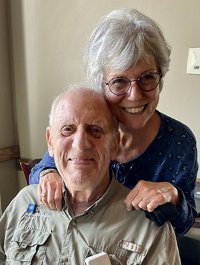 Moving to California
An avid coin collector, Bob enjoyed spending his time playing sports like tennis and soccer. While living on the East Coast, Bob met his wife Amy at a mutual friend’s party. They were married in 1981 and had two children, David and Laura.
Bolstered by a master’s degree in accounting, Bob spent the bulk of his career as a consultant, installing computer systems in law firms. Because Amy is roughly 15 years younger, Bob worked into his 70s before he retired.
In his 80s Bob began to have trouble completing tasks, like filing their taxes. Bob’s cognitive decline suffered after he experienced a major heart incident and had to undergo open heart surgery. Because of the anesthesia, Bob awoke to find his memory problems had taken a turn for the worse. “That pushed him from what was probably mild [dementia] into something that was more serious,” said Amy. “He never came back from that.”
In 2020, Bob was diagnosed with vascular dementia. It was around this same time that Laura announced that she and her fiancé (now husband) wanted to move to Northern California and invited Bob and Amy to join them. “They wanted to make that life change,” says Amy. “It was [during the COVID-19 pandemic]. I couldn’t imagine going through Bob’s decline without them. My sister lives out here too. It wasn’t a hard decision.”
Finding support
Once Amy and Bob were settled in the North Bay, Amy began searching for a support group. She attended a few but none of them were a good fit until she found the early-stage support group. “I tried several groups, and they were too large or I wasn’t comfortable sharing,” says Amy. “I found [the early-stage group] and it worked out really well for us.”
The early-stage group is designed as two support groups that run concurrently. One is for the person living in the early stages of the disease and the other is for their care partner.
“Bob always looks forward to going,” says Amy. “He forgets many things, but he never forgets we’re going to group. He likes the camaraderie and kidding around with the guys. He always says when he leaves, ‘I’m so glad to be in a group with people who are going through what I’m going through.’”
Bob isn’t the only one who has been enjoying the group. Amy has also found friendship and a place where she can bounce ideas off of other people who are experiencing the same caregiving challenges she is. “When I was struggling with the decision of having Bob move into a care setting, it was good to talk that out with the group,” says Amy. “It helped to have the reassurance I was doing the right thing. I think it is interesting to understand people’s stories and different ways of approaching this challenge. It gave me so much insight into how different people respond to the same challenges I face.”
Dementia and the holidays
While a dementia diagnosis prompts many changes in the home, one thing not often talked about is how this change can affect how holidays are celebrated.
The holidays are often filled with sharing, laughter and memories, but they can also bring stress, disappointment or sadness. A person living with Alzheimer’s or another dementia may feel a special sense of loss during the holidays because of the changes he or she has experienced. At the same time, caregivers often feel overwhelmed by maintaining traditions while providing care and adhering to safety precautions. Below are things to think about in order to safely enjoy time with family and friends during the holidays.
- Adjust expectations
- Involve the person living with dementia
- Connect through technology
- Adapt gift giving
- Familiarize others with the situation
- Protecting health
 Managing expectations
For Amy, the hardest holiday for her was their anniversary (they just celebrated their 44th). Before the disease, the couple would celebrate the day with travel or do something special locally. Now Amy had to come up with a new plan. It took Amy three years to figure out a solution that works for both her and Bob.
“The first time it came up was the first anniversary where he was in care setting,” says Amy. “I thought I’d make a big deal, a fancy restaurant, and make the day feel special. That day ended up falling really flat for me. It was pretending to be all happy when really it was very painful to try to pretend everything was okay.
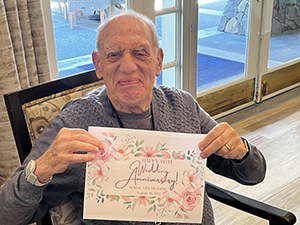
“The second year I didn’t plan a celebration, but that made me very sad. This year, I thought, okay I’m not going to ignore it or make a big deal of it, we’ll just have a pleasant time together. Go to a nice local restaurant and talk and not get all dressed up and not expect anything. As it turned out, the activities director knew it was our anniversary and helped him make a card, which also made the day special.
“I didn’t have expectations, and I think that was the key to making the day relaxed and enjoyable for us both. My advice: Don’t expect special holidays to be the same, it’s going to be different. It will still be meaningful but in a very different way. It makes sense: our marriage has changed since Bob’s diagnosis and therefore we are finding new ways to celebrate.”
Next year will mark Bob and Amy’s 45th wedding anniversary. She’s already set her mind to not make a big deal out of it and instead plans to have a quiet dinner with the whole family. Amy says, “It will be really nice and special day, but not a party.”
Enjoy yourself
Amy wants to remind caregivers that adjusting to holidays after a dementia diagnosis takes time. “Step back and let the person take the lead in terms of setting the tone of how [the holiday] should be,” says Amy. “Don’t push it or make it more than they can handle. Everything changes, this is one of those changes. This may be painful, but you have the opportunity to create new traditions.
“Take care of yourself. Sharing the time with family and friends can be very joyful for everyone, and being a caregiver doesn’t mean you can’t enjoy yourself too even though the joy is tinged with loss. It’s taken me four years to come to terms with the new normal, and it’s always changing. Your loved one will keep changing — and you have to keep changing and adjusting with them.”
For more information on how to celebrate holidays visit alz.org/holiday. The Alzheimer’s Association is here to help all year long, even during the holidays. Call the 24/7 Helpline at 800.272.3900 day or night for advice or support.