

Be a Part of the Fight to End Alzheimer's
Be a Part of the Fight to End Alzheimer's
The millions of people impacted by Alzheimer's disease need your help. Your generosity can help us provide care and support to these facing the challenges of Alzheimer's, protect brain health and advance global research. Please make a gift today.
Donate NowCharitable Lead Trust (CLT)

A charitable lead trust (CLT) is a good choice if you want to see the impact of your donation right away while also providing for your family in the future. You start by transferring assets to the trust, then make gifts to the Alzheimer's Association from the trust for a fixed number of years. Once that time is up, the remaining assets go back to you or your loved ones.
How a charitable lead trust works
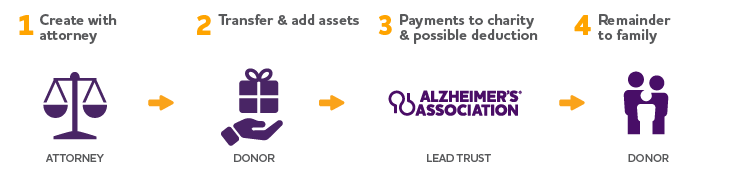
- You consult and build a plan with your attorney or advisor. Outline the structure and timing for the trust that works for your family and situation.
- Establish the trust. To create a CLT, you, the grantor, transfer assets — such as cash, stock, real estate or other investments — into the trust. These assets become the property of the trust and are managed by a trustee. The trust agreement outlines how these assets will be distributed to the Alzheimer's Association.
- Charitable payments. The trustee makes regular payments from the trust to the Alzheimer's Association for the duration specified in the trust agreement. These payments can be made in one of two ways:
- Charitable lead annuity trust (CLAT): Payments are made as a fixed annual amount, providing consistent support to the charity.
- Charitable lead unitrust (CLUT): Payments are based on a fixed percentage of the trust's fair market value, which can fluctuate over time.
- Remainder distribution. Once the trust term expires, the remaining assets are distributed to the designated beneficiaries. The transferred assets are typically free of gift or estate taxes.
Benefits of giving through a CLT
- You may receive a charitable tax deduction upon funding the trust.
- At the end of the trust's term, you or your loved ones receive the appreciation from the trust assets.
- If the trust assets are transferred to your loved ones, they are not subject to estate and gift taxes.
- The annual income from your trust supports the fight against Alzheimer's and all other dementia today.

Free Resources to Help You Plan
Learn More About Planned Giving
Find your local Alzheimer's Association Planned Giving Advisor
Our planned giving team is here to answer questions about including the Alzheimer's Association in a will, trust, beneficiary designations or other legacy planning opportunities.
Contact the planned giving team
Jill Workman
Alzheimer's Association
Senior Director, Planned Giving
Phone: 866.233.5148
Email: plannedgiving@alz.org

The information provided on this website is presented solely as general educational information and is not intended to be a substitute for professional estate planning, financial or legal advice. It is important to consult with a tax, financial and/or legal advisor about your specific situation.