Twice the Impact During the Dog Days of Summer
Twice the Impact During the Dog Days of Summer
Our End of Summer 2x Match is underway, but not for long. From now until midnight on Aug. 31, your gift can have double the impact on advancing research and helping provide care and support for those impacted by Alzheimer’s.
Donate NowGiving Through a Donor-Advised Fund (DAF)

Donor-advised funds
If you have a donor-advised fund (DAF), you can make a grant recommendation to the Alzheimer's Association today to help further lead the way in Alzheimer's treatment and research.
A DAF is like a charitable savings account. You contribute assets such as cash, securities or other investments to a fund, which are then managed and invested by a sponsoring organization — often a financial institution. Recommendations can be made where and when for grant distribution to IRS qualified charities.
You may receive a tax deduction based on the fair market value when you contribute to the fund.
It's important to note that every donor-advised fund must ultimately benefit a public charity. Designating the Alzheimer's Association as your final charitable beneficiary will ensure any remaining funds are distributed if the fund becomes inactive or upon the donor's passing.
How a donor-advised fund works
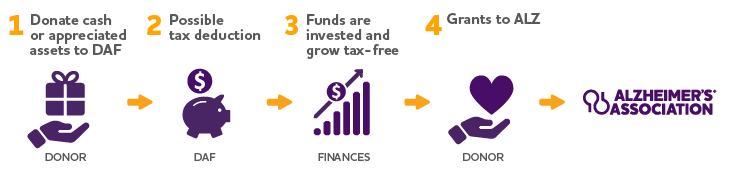
- Contribution. To establish a donor-advised fund, you contribute assets such as cash, securities, or even real estate, to the sponsoring organization. Your contribution is irrevocable, meaning that once donated, the assets belong to the sponsoring organization.
- Investment. The sponsoring organization invests the assets to grow the fund. You may have some influence over investment preferences, such as selecting portfolios that align with risk tolerance or values. Growth within the fund is tax-free, enhancing its charitable potential.
- Grant recommendation. You submit recommendations for grants to charities, specifying the amounts and recipients. While the final approval lies with the sponsoring organization, most recommendations are honored as long as the charities meet eligibility requirements, gifts do not benefit you and adhere to the fund's guidelines.
Benefits of a donor-advised fund
- Flexibility in giving. DAFs allow you to recommend grants at your own pace, making them ideal if you prefer to spread donations over months or years.
- Investment growth. Assets within a DAF can be invested for growth, increasing the potential support for the Alzheimer's Association. Professional fund management ensures that contributions are handled responsibly and can generate additional resources for future giving.
- Simplified administration. DAFs reduce the administrative burden of charitable giving. You don't need to track receipts from individual donations or deal with the complexities of direct contributions. The sponsoring organization handles all paperwork and distributions.
- Anonymity. For donors who prefer privacy, DAFs allow for anonymous grant-making. This feature ensures that donors can support causes discreetly without public recognition.
Already have a DAF?

Free Resources to Help You Plan
Learn More About Planned Giving
Find your local Alzheimer's Association Planned Giving Advisor
Our planned giving team is here to answer questions about including the Alzheimer's Association in a will, trust, beneficiary designations or other legacy planning opportunities.
Contact the planned giving team
Jill Workman
Alzheimer's Association
Senior Director, Planned Giving
Phone: 866.233.5148
Email: plannedgiving@alz.org