
Women and Alzheimer's
More than 12 million women in the United States live with or care for somebody who is living with Alzheimer's. Learn more about women and dementia, caregiving, and what the Alzheimer's Association is doing to support women affected by Alzheimer's.
Quick facts

In the United States, more than 12 MILLION WOMEN are either living with Alzheimer’s or caring for someone who has it.

Almost TWO-THIRDS of Americans living with Alzheimer’s are women.

Women in their 60s are more than TWICE AS LIKELY to develop Alzheimer’s disease over the rest of their lives as they are to develop breast cancer.

MORE THAN 60% of Alzheimer’s and dementia caregivers are women. More specifically, over one-third of dementia caregivers are daughters.

Women take on MORE CAREGIVING TASKS than their male counterparts – and care for people with more cognitive, functional, and/or behavioral problems.

Nearly 19% of women Alzheimer’s caregivers had to QUIT WORK either to become a caregiver or because their caregiving duties became too burdensome.

The overwhelming majority of dementia caregivers who indicate a need for individual counseling and respite care are women.
Women at risk
 Almost two-thirds of Americans living with Alzheimer's are women. Of the 7.4 million people age 65 and older with Alzheimer’s in the United States, 4.5 million are women.
Alzheimer’s disease is fatal. Women in their 60s are about twice as likely to develop Alzheimer's during the rest of their lives as they are to develop breast cancer. A woman's estimated lifetime risk of developing Alzheimer's at age 65 is 1 in 5.
There are a number of potential biological and social reasons why more women than men have Alzheimer’s or other dementias. The prevailing view has been that this discrepancy is due to the fact that women live longer than men on average, and older age is the greatest risk factor for Alzheimer’s. Researchers are now questioning whether the risk of Alzheimer’s could actually be higher for women at any given age due to biological or genetic variations or differences in life experiences.
How women can reduce their risk
While we don't have a definitive answer to preventing Alzheimer's, research has shown that people can take action to reduce the risk of developing it by leading a healthy lifestyle. Physical exercise, social connections, a healthy diet and keeping mentally active all play a role. We need more large-scale studies in diverse populations to understand more.
Why do more women develop Alzheimer's than men?
In the United States, nearly two-thirds of the more than 7 million people living with Alzheimer’s are women. Researchers are pursuing every avenue to discover answers.
Women and caregiving
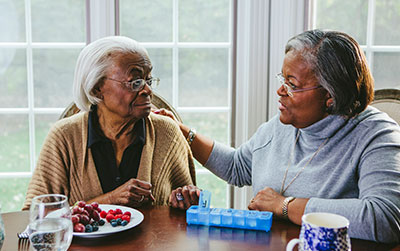 Not only are women more likely to have Alzheimer's, they are also more likely to be caregivers of those living with Alzheimer's.
Nearly half of all caregivers who provide help to older adults do so for someone living with Alzheimer's or another dementia, and 83% of the help provided to older adults in the United States comes from family members, friends or other unpaid caregivers.
Statistics show that the responsibilities of caring for someone with dementia often fall to women:
- More than three in five unpaid Alzheimer's caregivers are women. This affects multiple generations, as it is more common for wives to provide informal care for a husband than vice versa, and more than one-third of dementia caregivers are daughters.
- On average, female caregivers spend more time caregiving than male caregivers. In fact, there are 2.5 times more women than men who live with the person with dementia full-time.
- Because of caregiving duties, women are likely to experience adverse consequences in the workplace. Nearly 19% of women Alzheimer's caregivers had to quit work either to become a caregiver or because their caregiving duties became too burdensome.
Women caregivers may experience higher levels of depression and impaired health than their male counterparts. Evidence suggests these differences arise because female caregivers tend to spend more time caregiving, to take on more caregiving tasks, and to care for someone with greater cognitive, functional and/or behavior problems.
Resources for caregivers: Learn what to expect during the different stages of caregiving and how to sustain your own mental, physical and emotional health.
Help is available
- Call our free 24/7 Helpline: 800.272.3900. The Alzheimer’s Association is here all day, every day for people facing Alzheimer’s and other dementia through our free 24/7 Helpline. Talk to a dementia expert now and get confidential emotional support, local resources, crisis assistance and information in over 200 languages. It's ok if you don't know where to start. Just give us a call and we'll guide you from there.
- Locate the Alzheimer's Association chapter near you. Get local resources, support and information, and connect with others facing Alzheimer's in your community.
Association research on women and Alzheimer's
Since 2016, the Alzheimer’s Association has committed $11 million to science that aims to unlock the mysteries of Alzheimer’s in women. The Association has awarded more than 50 grants across six countries to better understand the biological and social factors that may explain the differences in Alzheimer's prevalence between women and men.
The Association has increased its focus on research about the relationship between biological sex and the brain. There is a need for the field to focus on sex hormones, including menopause transition, estrogen levels, hormone therapy and the use of gender-affirming hormones.
Read the Alzheimer’s Association statement on Postmenopausal Hormone Therapy and Cognition (PDF).
Our research initiatives dedicated to exploring Alzheimer’s in women include:
- The Women’s Alzheimer’s Research Initiative (WARI) explores the links between gender and vulnerability to Alzheimer’s. The research and global awareness powered by WARI are inspiring a new wave of scientific interest and exploration. Using data generated with our awards, WARI-funded scientists have obtained over $70 million in public funding to scale their research.
- The Sex and Gender in Alzheimer’s (SAGA) grant funding program supports scientific investigation that addresses gaps in our understanding of the role biological sex and related genetic, biological, lifestyle and societal factors may play in increasing vulnerability to Alzheimer’s.
Association partnerships
At the Alzheimer's Association, we believe that diverse perspectives are critical to achieving health equity — meaning that all communities have a fair and just opportunity for early diagnosis and access to risk reduction and quality care. The Association is committed to engaging underrepresented and underserved communities and responding with resources and education to address the disproportionate impact of Alzheimer’s and dementia. The Alzheimer's Association works to address health disparities and advance equity and inclusion with national and local organizations, including:
- Chi Eta Phi Sorority, Incorporated (CEP)
- Sigma Gamma Rho Sorority, Inc.
- The Links, Incorporated
- Zeta Phi Beta (ΖΦΒ)