
HBI Road Map for American Indian and Alaska Native Peoples
The Healthy Brain Initiative (HBI): Road Map for American Indian and Alaska Native Peoples (PDF) offers public health strategies and actions to improve brain health throughout life.
It promotes health equity by using a strength-based approach that honors diverse American Indian and Alaska Native (AI/AN) cultures and incorporates the indigenous determinants of health. It is developed with respect to tribal sovereignty and is influenced by the traditions of AI/AN peoples.
- HBI Road Map for AI/AN Peoples (PDF)
- Executive Summary (PDF)
- What's New (PDF)
- Implementation Guide (PDF)
Road Map for public health action
 Download the Road Map for AI/AN Peoples
Find 13 public health strategies to help American Indian and Alaska Native communities improve brain health, address dementia and better meet the needs of caregivers. View and download a PDF of the Road Map.
There are 574 federally recognized and sovereign American Indian tribes, nations, pueblos, bands and Alaska Native villages in the United States, as well as state-recognized tribes and many other communities without federal or state recognition. All have their own history, traditions, cultures and practices.
It is estimated that 87% of AI/AN peoples live in urban areas, which has resulted in a mixing of practices and a coming together of communities. These strengths, which are the foundation of the indigenous determinants of health, build resilience for members of those communities and should be incorporated when planning public health action.
Developed as a companion to the Healthy Brain Initiative: State and Local Road Map for Public Health, 2023-2027, the Road Map for AI/AN Peoples builds on what was learned from the implementation of the first Road Map for Indian Country (PDF). Learn more about the history of the HBI Road Map Series.
The Road Map for AI/AN Peoples suggests 13 public health strategies as a starting point for discussion, deliberation and cross-sector collaboration. Public health professionals working in tribes and urban Indian organizations are encouraged to discuss these strategies with their community and involve members in planning and implementing these community-wide approaches. Collectively, the strategies aim to improve health and well-being of AI/AN people, address cognitive impairment and help support caregivers of people living with dementia.
Get started with the HBI Road Map for AI/AN Peoples
The Road Map can help professionals conducting public health work with tribes, nations, pueblos, bands, villages and urban Indian organizations select and pursue strategies for the AI/AN communities they serve to improve brain health, address dementia and better meet the needs of caregivers. This includes tribal public health professionals and tribal professionals with public health experience working in community and clinical health settings.
To support the use of the Road Map, several ready-made tools and resources can help public health leaders prioritize actions and tailor their work to best fit the needs of the community.
- What's New (PDF): Explore the changes in the HBI Road Map for AI/AN Peoples, including a focus on the indigenous determinants of health.
- Implementation Guide (PDF): This guide expands on key questions from the HBI Road Map to help public health professionals get started with choosing and implementing actions.
- Video overview: Watch this recorded webinar with members of the HBI Leadership Committee and experts from the Alzheimer's Association to learn about the development of the HBI Road Map for AI/AN Peoples.
Use topic-specific issue maps to lead change in your community
Topic-specific issue maps explore public health issues related to Alzheimer’s and other dementia. Each issue map explains the topic, identifies related Road Map actions and highlights implementation examples from AI/AN communities.
View issue maps covering key areas of focus:
- Advancing Early Detection and Diagnosis (PDF): Take action by advancing population health through early detection and diagnosis of dementia. Learn more: Early Detection and Diagnosis.
- Embracing Culture as Health (PDF): Learn about strength-based approaches that support population health in addressing dementia in culturally-centered ways.
- Promoting Brain Health and Risk Reduction (PDF): Support holistic health by promoting brain health and reducing the risk of cognitive decline through public health. Learn more: Risk Reduction.
- Strengthening Community-Clinical Linkages (PDF): Improve connections between health care providers and community-based organizations to improve outcomes for people living with dementia and their caregivers.
- Supporting Dementia Caregivers (PDF): Create a public health approach that effectively supports and meets the needs of dementia caregivers. Learn more: Caregiver Support.
Resources and data for public health leaders
Public health professionals in AI/AN communities are leaders in bringing their communities together to address brain health, dementia and caregiving. They are using innovative, strength-based approaches to serve their communities.Find public health resources by topic and audience
Get public health data, curriculum and listings of intervention models:
- BRFSS and other data resources: Find data on Alzheimer's, dementia and public health from BRFSS and other sources.
- Public health curriculum: Use a curriculum designed for schools and programs of public health and related disciplines.
Three success stories from the Road Map for Indian Country highlight how tribes worked to improve health outcomes related to dementia:
- Aleut Community of St. Paul Island: Strengthening Relationships to Improve Service (PDF)
- Cheyenne and Arapaho Tribes Department of Health: Education and Outreach for Increased Impact (PDF)
- Mt. Sanford Tribal Consortium: Time Together Builds Dementia Awareness and Advocacy (PDF)
Conceptual framework
The framework of the HBI Road Map for AI/AN Peoples is a wheel consisting of four domains built from the Essential Public Health Services and centered on the principle that culture is health.
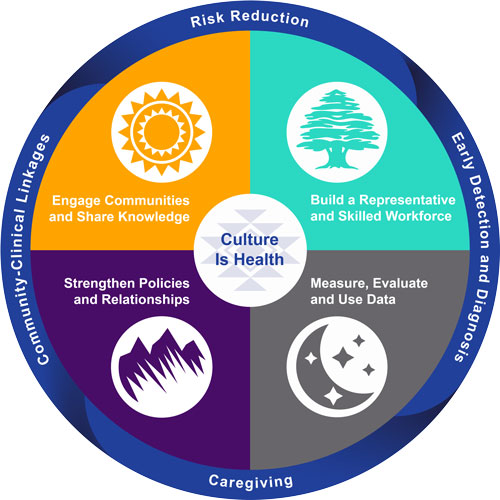 Engage Communities and Share Knowledge: Public health engages with AI/AN communities to understand how knowledge can be shared. Public health professionals in the community can then share practices to increase awareness about the factors that influence brain health and ways to maintain or improve cognitive health and ultimately quality of life. The sun icon symbolizes warmth, energy and growth as communities engage and share knowledge together.
Build a Representative and Skilled Workforce: Public health is responsible for training and preparing the public health and health care workforce to provide culturally centered and appropriate care to people at risk for or living with dementia while also supporting caregivers. The cedar tree icon represents protection and healing. The diverse uses of the tree call to mind the roles of the different members of the workforce.
Measure, Evaluate and Use Data: Public health supports data sovereignty while working with communities to monitor health status, identify and solve community health problems, and evaluate effectiveness, accessibility and quality of health improvement programs. Findings are shared with the community and used to inform programs and policies to improve brain health across the life course. The moon icon symbolizes the moon’s role as a guide and a timekeeper, signifying transformation and the importance of measurement and data.
Strengthen Policies and Relationships: Public health strengthens, supports and mobilizes community partnerships to improve brain health. Public health also creates, champions and implements supportive policies and plans by increasing awareness of dementia and its impact among tribal leadership. The mountain range icon signifies strength and sacredness, representing the power of policies and relationships.